How to cycle a new aquarium
The single most important step before adding fish, explained from the ground up, with the methods, numbers, and timeline you actually need.
Published 2 June 2026 · Last updated 1 July 2026 · 12 min read
What "cycling" actually means
When fish live in water, they constantly release ammonia through their gills and waste. Ammonia is highly toxic to fish: even small amounts cause gill damage and stress, and higher amounts kill within hours. A new tank filled with tap water has no way to remove it. Every fish placed in an uncycled tank is being slowly poisoned by its own waste.
Cycling is the process of growing two types of beneficial bacteria inside your filter and on every surface of the tank. These bacteria do the detoxifying for you:
- The first group (Nitrosomonas bacteria) convert ammonia into nitrite. Nitrite is still toxic, just slightly less so.
- The second group (mainly Nitrospira bacteria) convert nitrite into nitrate. Nitrate is far less toxic and is removed by water changes or taken up by live plants. (Older sources credit Nitrobacter for this step, but in home aquariums it is mostly Nitrospira.)
The full pathway looks like this:
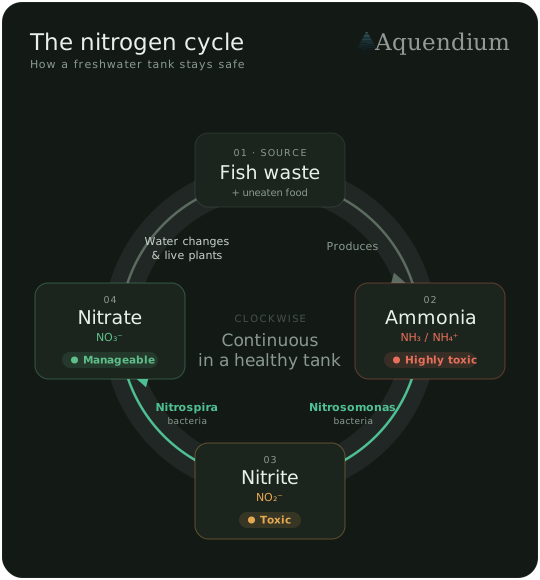
This is the nitrogen cycle. A tank is "cycled" when it has enough of these bacteria to convert all the ammonia your fish produce into nitrate, in real time, with no toxic residue left over. Until that point, adding fish does them measurable harm.
Why most beginners get this wrong
Pet shops routinely tell new customers their tank is ready after it has held water for a few days, or that they can "cycle with fish" by adding hardy species first. Both pieces of advice are wrong, and both kill fish.
A tank with water but no bacteria is not cycled; it is just full of water. The bacteria need an ammonia source to grow, and they do not appear from nothing. Cycling with fish (sometimes called fish-in cycling) uses living animals as that ammonia source, exposing them to days or weeks of toxic conditions. It does work in the sense that the cycle eventually establishes, but at the cost of fish welfare and often fish lives. Modern fishkeeping considers it poor practice.
The right approach is fishless cycling: provide a controlled ammonia source yourself, let the bacteria grow with no fish present, and only add livestock once the tank is processing ammonia to safe levels.
What you'll need
- A fully set-up aquarium with substrate, the filter running, the heater set to your intended fish's temperature range, and dechlorinated tap water.
- A liquid freshwater test kit that measures ammonia, nitrite, nitrate, and pH. The API Freshwater Master Test Kit is the most widely used. Avoid test strips, which are too imprecise at the low readings that matter here.
- An ammonia source: either pure ammonium chloride or plain fish food (both covered below).
- Patience. A fishless cycle typically takes 4 to 6 weeks. Anyone promising a 24-hour or 3-day cycle is selling you something.
Optional but useful
- A bottled bacteria starter (Dr Tim's One and Only, Seachem Stability, or Fritz TurboStart). These genuinely speed up the cycle when stored and used correctly. Older bottled products that sat on a shelf too long are far less effective; the modern refrigerated formulations are different.
- Filter media or substrate from an established tank, if you know another fishkeeper. A handful of mature filter media is the fastest cycle accelerator there is, sometimes turning weeks into days.
- Live plants. Plants absorb ammonia and nitrate directly and bring some bacteria with them. A heavily planted tank cycles faster and more gently.
Method 1: Pure ammonia (recommended)
This is the most precise and reliable method. You dose a measured amount of pure ammonia, test daily, and watch the cycle progress.
Step 1: Source pure ammonia
You need ammonium chloride (NH₄Cl) with no surfactants, perfumes, or additives: the kind sold specifically for aquarium cycling. Dr Tim's Ammonium Chloride and Fritz Fishless Fuel are the standard products. Household cleaning ammonia is not a safe substitute unless you can confirm it is pure ammonia with no other ingredients, which most are not.
Step 2: Dose to roughly 2 ppm ammonia
The target is 2 ppm of ammonia in the tank water. Higher concentrations (4 ppm and above) can actually stall the cycle by poisoning the very bacteria you are trying to grow. Your bottle of ammonia will include a dosing chart based on tank size (work out your tank's actual volume with our tank volume calculator), usually a few drops per litre. Follow the chart for your specific product.
After dosing, wait an hour for the ammonia to mix evenly, then test. Adjust if needed, and write down your dose so you can match it next time.
Step 3: Test every day, record everything
For the next several weeks, test ammonia, nitrite, and nitrate daily. Keep a simple log (a sticky note on the tank works fine) with the date and the three readings. You are watching for a specific pattern:
- Week one or so: ammonia stays high and nitrite reads zero. The first bacteria are still establishing.
- Around week two: ammonia starts to drop and nitrite begins to climb. This is the first sign the cycle is progressing, because the ammonia is being converted.
- The nitrite spike: nitrite climbs, often to very high readings (5 ppm or more). The nitrite-converting bacteria take longer to establish. This is the longest stage, and the point where impatient keepers give up.
- The finish: nitrite starts to fall while nitrate climbs. When both ammonia and nitrite read zero and nitrate is detectable, the bacteria are doing their job.
Step 4: Keep the bacteria fed
Once ammonia readings start dropping, redose back to 2 ppm. The bacteria need a continuous food supply, or they will die back and you will have to start over. Redose whenever ammonia drops to roughly zero, typically every one to three days as the cycle progresses.
Step 5: The final test
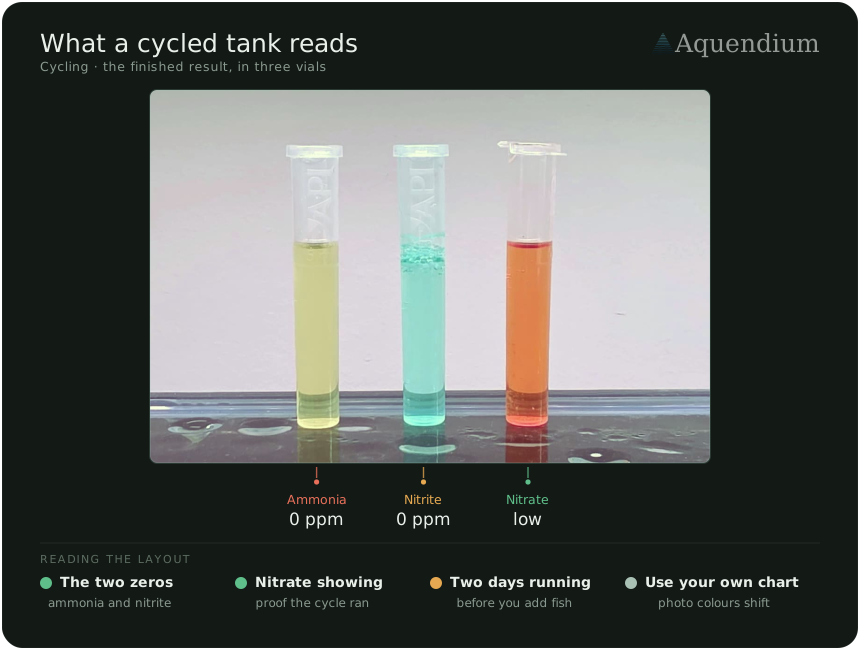
Your tank is cycled when, after dosing 2 ppm of ammonia, both ammonia and nitrite read zero within 24 hours. That proves your bacteria can process a meaningful waste load fast enough to keep fish safe.
Method 2: Fish food (slower but no ammonia purchase)
If you cannot source pure ammonia, plain fish food works as an ammonia source. As the food decomposes, it releases ammonia into the water. This method is slower and less precise, but it works and uses materials you already have.
How it works
Drop a small pinch of flake or pellet food into the empty tank every day, as if you were feeding invisible fish. The food sinks, decomposes, and releases ammonia gradually. The same nitrogen cycle establishes; it just takes longer to reach the ammonia levels that drive bacterial growth.
The tradeoffs
Fish-food cycling typically takes 6 to 8 weeks, sometimes longer. The ammonia levels are unpredictable: sometimes too low to feed the bacteria fast enough, sometimes high enough to stall the cycle. You also end up with a layer of decomposing food and brown muck, which is unsightly and needs a thorough clean before stocking.
If you choose this method, still test daily with a liquid test kit and watch for the same pattern: ammonia spike, nitrite spike, then both falling to zero with nitrate climbing. The progression is identical; only the timing and precision change.
How to know your tank is genuinely ready
The criteria are unambiguous:
- You dose ammonia to 2 ppm (or a final pinch of food).
- 24 hours later, ammonia reads 0 ppm.
- Nitrite reads 0 ppm.
- Nitrate reads above 0 ppm (typically 10 to 40 ppm).
- You get the same result two days in a row.
The day you add fish: final preparation
Before you visit the fish shop:
Do a large water change. At the end of a cycle, your nitrate is usually high (sometimes 40 to 80 ppm) because nothing has been removing it. A 50 to 75% water change brings nitrate down to a safe baseline before fish arrive. Use dechlorinated water at the same temperature as the tank.
Do not skip the dechlorinator. Australian tap water contains chlorine or chloramine, both of which kill the bacteria you spent weeks growing. Always treat fresh tap water with a conditioner like Seachem Prime or API Tap Water Conditioner before it touches your tank.
Stock gradually, not all at once. Your bacteria colony is sized for the ammonia load you have been dosing. Adding twenty fish on day one creates more waste than the colony can process, triggering a mini-cycle and an ammonia spike. Add a small group first (no more than a third of your intended stock), then wait two weeks before adding more. Test ammonia and nitrite during this period to catch any spike early.
Common problems and how to read them
Nothing is happening after two weeks
Usually one of three things: your ammonia dose is too high (above 4 ppm can stall the cycle), your pH is too low (below 6.5 slows the bacteria dramatically), or your water is too cool (bacteria establish fastest between 28 and 30°C). Test your pH and temperature, and reduce your ammonia dose if needed.
Ammonia drops but nitrite is stuck high for weeks
This is normal. The nitrite-converting bacteria are slower to establish than the ammonia-converters, and the nitrite spike is the longest stage of the cycle. Keep going. It will resolve, often suddenly, somewhere between weeks three and five.
My pH crashed
Cycling produces acid as a byproduct, which gradually uses up the water's buffering capacity. If pH drops below 6.5, the cycle stalls. A small water change (25%) brings the pH back up and restores buffering. Test pH weekly and do a water change if it starts to drop.
The cycle "stalled": readings have stopped progressing
Usually one of: pH too low (fix with a water change), too much ammonia (let it drop, then dose lower), or starving bacteria (you stopped dosing too soon). Diagnose by checking pH and your current readings, then adjust.
How to keep a cycled tank cycled
Once cycling is complete and fish are in, the bacteria colony self-regulates to match your stocking and feeding. Three things will damage or destroy that colony:
Cleaning filter media in tap water. Chlorine kills bacteria. Rinse media only in old tank water (the water you remove during a water change), and only when flow is genuinely restricted, not on a routine.
Replacing all filter media at once. Most of your bacteria live in the filter. Swapping all the media at the same time throws out the colony. Replace media gradually as it physically breaks down, and only one component at a time.
Long power outages or dry spells. Without water flow, the bacteria suffocate within 24 to 48 hours. If your filter has been off for more than a few hours, expect a mini-cycle and test daily for ammonia over the following week.
What to do next
Once you are confident on the theory, the practical sequence is straightforward:
- Set up your tank fully: substrate, filter, heater, dechlorinated water, lights on a timer.
- Choose your cycling method: pure ammonia for precision, fish food if you cannot source ammonia.
- Start dosing, test daily, and record every reading.
- Be patient through the nitrite spike. It is normal and it resolves.
- Confirm a full 24-hour process of 2 ppm ammonia down to zero ammonia and zero nitrite, two days running.
- Do a large water change to lower nitrate.
- Add your first small group of fish.
- Test ammonia and nitrite daily for the first fortnight after adding fish.
A patient cycle is the single best gift you can give your future fish. The four to six weeks of waiting feels long, but it sets up years of healthy, low-maintenance fishkeeping. Rushing this step is the most common reason new tanks fail.
Before cycling, see our guide on setting up a new aquarium. Before adding fish, see choosing your first fish. Once your tank is stocked, the most important ongoing tasks are regular water changes and monitoring your water parameters.