Melbourne tap water for aquariums
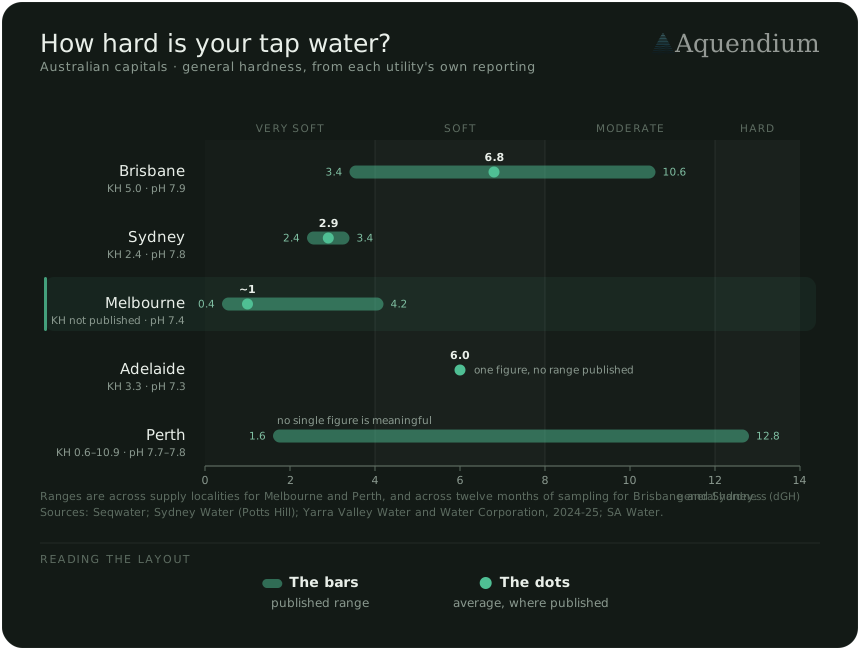
Melbourne has the softest tap water of any Australian capital, and it is not close. Where Brisbane runs near 120 ppm hardness, much of Melbourne sits between 8 and 31, which is barely one degree of hardness. That is a genuine gift if you want tetras, rasboras or discus, and a genuine hazard if you do not understand what comes with it. It also carries one widely repeated myth worth clearing up straight away: Melbourne water is not acidic. Here are the real numbers, from Yarra Valley Water's own annual testing.
Published 29 July 2026 · Last updated 29 July 2026 · 9 min read
The numbers, in fishkeeping units
Yarra Valley Water publishes averages for each sampling locality, so Melbourne can be described with unusual precision. Converted at 1 dGH = 17.86 ppm, which our hardness converter does both ways.
| Parameter | As reported | In aquarium units | What it means |
|---|---|---|---|
| General hardness (GH) | Mostly 14 to 31 ppm by locality | About 1 dGH | Softer than most bottled water |
| pH | 7.3 to 7.5 locality averages | Around 7.4 | Neutral, not acidic |
| Carbonate hardness (KH) | Not published by locality | Very low | Expect minimal buffering. Test yours |
| Free chlorine | 0.33 to 0.49 ppm | Gasses off over time | Chlorine, not chloramine |
Find your suburb
Yarra Valley Water publishes which sampling locality serves each suburb, so this can be given by postcode rather than by their internal zone names. Softest first:
| Suburb (postcode) | Hardness | In dGH |
|---|---|---|
| Healesville, Badger Creek, Chum Creek (3777) | 8 ppm | 0.4 dGH |
| Yarra Glen (3775) | 8 ppm | 0.4 dGH |
| Monbulk (3793), Olinda (3788), Sassafras (3787) | 14 ppm | 0.8 dGH |
| Emerald (3782), Cockatoo (3781) | 15 ppm | 0.8 dGH |
| Kew (3101), Hawthorn (3122), Camberwell (3124) | 18 ppm | 1.0 dGH |
| Box Hill (3128), Blackburn (3130), Mitcham (3132) | 18 ppm | 1.0 dGH |
| Seville (3139) | 18 ppm | 1.0 dGH |
| Glen Waverley (3150), Oakleigh (3166), Clayton (3168) | 19 ppm | 1.1 dGH |
| Ivanhoe (3079), Heidelberg (3084) | 19 ppm | 1.1 dGH |
| Glenroy (3046), Broadmeadows (3047) | 19 ppm | 1.1 dGH |
| Malvern (3144), Ashburton (3147) | 20 ppm | 1.1 dGH |
| Brunswick (3056), Northcote (3070) | 24 ppm | 1.3 dGH |
| Craigieburn, Roxburgh Park, Mickleham (3064) | 25 ppm | 1.4 dGH |
| Bundoora (3083), Thomastown (3074) | 26 ppm | 1.5 dGH |
| Kangaroo Ground (3097), Panton Hill (3759) | 30 ppm | 1.7 dGH |
| Epping (3076), South Morang (3752), Mernda (3754) | 37 ppm | 2.1 dGH |
| Whittlesea | 75 ppm | 4.2 dGH |
Some suburbs sit on the boundary between two sampling localities and can receive either, so treat a nearby suburb's figure as an indication rather than a guarantee. Yarra Valley Water publishes the full suburb list in its annual report if yours is not above.
Even Whittlesea, the hardest locality on the network, is softer than Brisbane's average. If you live in the north, though, you have meaningfully more mineral content to work with than someone in Healesville, whose water is close to distilled.
The myth: Melbourne water is not acidic
Melbourne is routinely described as having soft, acidic water, and the second half is wrong. Yarra Valley Water's locality averages sit at pH 7.3 to 7.5, which is neutral to very slightly alkaline.
The confusion is understandable, because soft and acidic usually travel together, and because Melbourne tanks often do turn acidic. But that is the tank drifting, not the tap arriving that way. Knowing the difference matters: if you assume your tap is already acidic you may skip the buffering a soft-water tank needs, and then be surprised when the pH falls much further than you intended.
The real risk: almost nothing holds your pH
This is the thing to understand if you keep fish in Melbourne, and it follows directly from the softness.
A tank continuously produces acid as waste breaks down. KH is what neutralises it. Melbourne's mineral content is so low that KH is minimal, which means there is very little standing between your tank and a falling pH. In a well-maintained tank this is a non-issue. In a neglected, overstocked or overfed one, the pH can drop far and fast, and a sudden pH crash kills fish outright rather than slowly.
Three habits remove the risk almost entirely:
- Keep up regular water changes. Every change resets whatever buffering the tap provides. This matters more here than in Brisbane or Adelaide (see our water changes guide).
- Do not overstock or overfeed. Both accelerate acid production, and there is little in reserve to absorb it (see stocking a community tank).
- Add a little buffering if you want a margin. A small amount of crushed coral in the filter dissolves slowly, raises KH gently, and is self-regulating. For most Melbourne community tanks this is the single most useful thing you can add.
Chlorine, not chloramine
Melbourne is one of the few Australian capitals that still disinfects with free chlorine rather than chloramine. Yarra Valley Water reports residuals of roughly 0.33 to 0.49 ppm, and chloramine is not used at all.
The practical difference is real. Chlorine gasses off from standing water, so a bucket left overnight (better still with an airstone in it) genuinely does become safer, which is not true in Brisbane or Sydney. That said, a dechlorinator is faster, completely reliable, and removes the guesswork about how long is long enough, so we still recommend using one. Seachem Prime or API Tap Water Conditioner both work, and our water conditioner calculator gives the dose.
Fish that suit Melbourne water
Very soft, neutral water is exactly what a large and desirable group of fish evolved in.
- Tetras and rasboras thrive. Neon tetras, chili rasboras, harlequin rasboras and their relatives are at home at 1 dGH, showing better colour than they typically do in harder cities.
- Dwarf cichlids and discus become genuinely realistic. The German blue ram, apistogramma and discus all want soft water, and Melbourne provides it without RO equipment. Keepers elsewhere in Australia spend real money to get what comes out of your tap.
- Caridina shrimp such as crystal reds are far more approachable here, though they still want lower pH and will need an active soil.
- Most peaceful community fish including corydoras and small barbs are fine.
The groups that need help are the mineral-dependent ones. Livebearers (guppies, platies, mollies) want far more GH than 1 dGH and will be visibly happier with supplementation. Snails (nerites, mystery snails) cannot build shell properly in water this soft and will develop pitting and erosion. Shrimp of all kinds need GH to moult successfully, and cherry shrimp in unmodified Melbourne water often fail mid-moult. For all three, add minerals rather than hoping.
When to add minerals
Melbourne is the one Australian city where adding is routinely the right call, and happily, raising hardness is much easier than lowering it.
- Crushed coral or aragonite in the filter or substrate. Dissolves slowly, raises both GH and KH, self-regulating, and cheap. The default recommendation for a Melbourne community tank.
- A GH booster or remineralising salt if you want precise control, particularly for a shrimp tank where the target range is narrow. See our shrimp guide.
- Nothing at all if you are keeping tetras, rasboras or dwarf cichlids and maintaining the tank properly. Do not fix what suits your fish.
Suburbs and the three retailers
Melbourne is supplied by three retailers, and the figures above come from Yarra Valley Water, which covers the north and east. South East Water serves the south and southeast, and Greater Western Water the west and northwest. Their sources overlap heavily through the protected Yarra catchments, so the soft, neutral character holds city-wide, but the precise numbers will differ.
Within the Yarra Valley network the range runs from 8 ppm at Healesville to 75 at Whittlesea, roughly a tenfold spread. Everything in that range is soft by aquarium standards, so it will not change which fish you can keep. It does affect how much buffering you start with, so if you are keeping shrimp or breeding, test your own tap rather than relying on a city figure.
Related reading: aquarium water parameters explained, best freshwater fish for Australian tap water, and aquarium water changes, or browse the species directory.