Sydney tap water for aquariums
Sydney has the most versatile tap water of any Australian capital, and an unusual profile behind it: very soft, yet clearly alkaline. That combination is what makes almost anything peaceful keepable straight from the tap, and it is also the source of the one problem Sydney tanks reliably develop after a few months. Here is what is actually in it, from Sydney Water's own quarterly testing, and what it means for your tank.
Published 29 July 2026 · Last updated 29 July 2026 · 9 min read
The numbers, in fishkeeping units
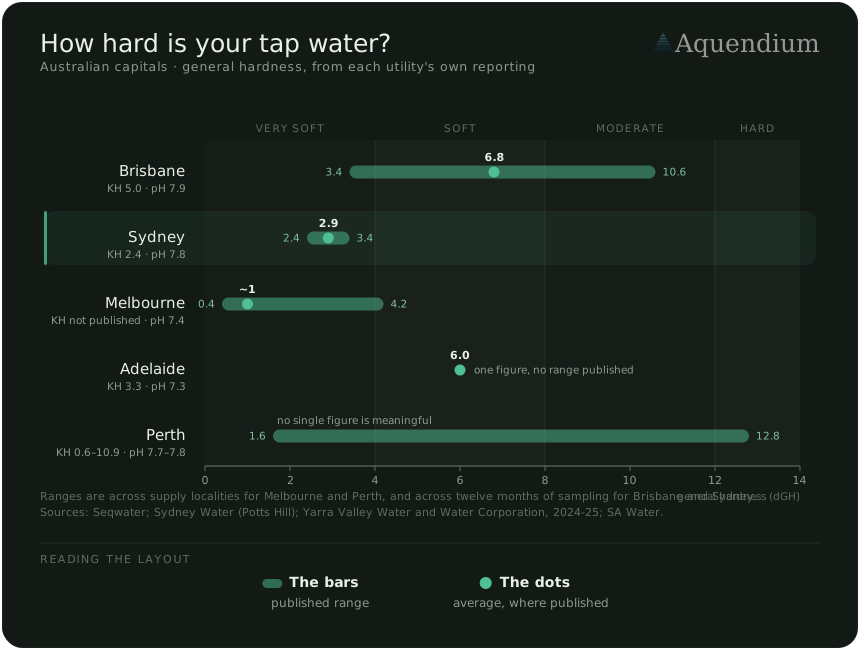
These are Sydney Water's published figures for the Potts Hill delivery system, which draws from Prospect and supplies a large share of the city. Converted at the standard 1 dGH = 17.86 ppm, which our hardness converter handles both ways.
| Parameter | As reported | In aquarium units | What it means |
|---|---|---|---|
| General hardness (GH) | 51 ppm average (43 to 61) | 2.9 dGH | Very soft |
| Carbonate hardness (KH) | 42 ppm alkalinity (40 to 44) | 2.4 dKH | Light buffering, pH can move |
| pH | 7.8 average (7.65 to 7.92) | 7.8 | Alkaline, despite the softness |
| Chloramine | 0.88 ppm (free chlorine only 0.04) | Must be neutralised | Chloraminated. Dechlorinator every time |
| Total dissolved solids | 126 ppm average | Low | Clean, lightly mineralised water |
A useful cross-check: Sydney Water also reports calcium (11.5 to 16.3 ppm) and magnesium (2.74 to 5.46 ppm), and calculating hardness from those gives about 52 ppm, matching the 51 ppm they report directly.
Soft and alkaline, and why that is unusual
Most people assume soft water means acidic water. It often does, because the same geology that leaves few dissolved minerals also leaves little to neutralise acids. Sydney breaks that pattern: the water carries very few minerals (2.9 dGH) yet holds a pH of 7.8.
For fishkeeping this is mostly excellent news. GH is what matters most to fish, because it governs the osmotic balance they evolved around, and Sydney's low GH means soft-water species that struggle elsewhere in Australia are comfortable here without any treatment. Meanwhile the alkaline pH keeps hard-water favourites like livebearers perfectly happy too. That is the real reason Sydney is called the most flexible water in the country: it is not that the water is average, it is that low GH plus alkaline pH satisfies both camps at once.
The slow pH slide, and how to stop it
Here is the one genuinely Sydney-specific problem, and it takes months to appear, which is why people rarely connect it to their water.
KH is the tank's shock absorber. It neutralises the acids that a tank produces continuously as fish waste breaks down, food decays and the biological filter works. Sydney's KH is 2.4 dKH, which is enough to hold pH steady in a well-maintained tank but not much more. In a tank that is heavily stocked, generously fed, or overdue for water changes, that buffering gets consumed and the pH begins to fall. Left long enough it can drop sharply, which is stressful at best and lethal at worst.
The fix is unglamorous and completely effective: regular water changes. Every change brings in fresh KH and resets the buffer, which is precisely why the standard 25% weekly change matters more in soft-water cities than in Brisbane. Our water changes guide covers the routine.
Chloramine: standing water will not do
Sydney Water disinfects with chloramine, chlorine bonded to ammonia, running around 0.88 ppm with almost no free chlorine present. The practical consequence is the one that catches people out: chloramine does not evaporate. The traditional advice to leave a bucket standing overnight works for chlorine and does nothing here.
Treat every drop of water going into the tank, every time, including top-ups. A conditioner rated for chloramine (Seachem Prime or API Tap Water Conditioner) handles it, and our water conditioner calculator works out the dose. Sydney's level is modest by national standards, roughly a third of Brisbane's, but the requirement is identical because it is the chemistry, not the concentration, that makes standing water useless.
Fish that suit Sydney water
Very soft, alkaline, lightly buffered water is a broad canvas. Almost anything peaceful works, which is genuinely unusual.
- Soft-water species do well here, and that is Sydney's real privilege. Neon tetras, chili rasboras, harlequin rasboras and most small tetras suit 2.9 dGH straight from the tap, where keepers in Brisbane or Adelaide have to compromise.
- Dwarf cichlids such as the German blue ram and apistogramma are far more achievable here than in most of the country.
- Community staples including corydoras, danios and gouramis are entirely at home.
- Caridina shrimp like crystal reds are within reach with less RO work than elsewhere, though they still want lower pH than the tap provides.
Two groups want a little help. Livebearers (guppies, platies, mollies) enjoy the alkaline pH but their ideal GH is well above 2.9, so add crushed coral or a GH booster if you want their best colour and breeding. Snails (nerites, mystery snails) need calcium for shell growth and can develop pitting in water this soft, so the same mineral top-up helps them. Cherry shrimp sit in between: they live happily but moult more reliably with a little more GH.
When to adjust it, and when not to
Sydney is one of the few Australian cities where the honest answer is usually "leave it alone and enjoy it". The water suits more fish unmodified than almost anywhere else in the country.
The exceptions are narrow. Raising GH for livebearers, snails or a rift cichlid tank is easy and worthwhile: crushed coral in the filter or an aragonite substrate does it gradually and self-regulates. Lowering pH for a dedicated soft-water biotope or Caridina shrimp tank is achievable but needs care, because with only 2.4 dKH the pH will move quickly once you start pushing it, so use an active soil rather than pH-down chemicals. And raising KH is worth considering if your tank runs a heavy bioload, purely for stability.
Systems, suburbs and rainwater
The figures above are for the Potts Hill system fed from Prospect, which covers a large share of Greater Sydney, but the city is supplied by several delivery systems. The Blue Mountains, the Illawarra, Macarthur and the Nepean systems each draw on different sources and can differ, generally in the direction of even softer water. The broad character, soft and alkaline, holds across the network.
Two things change the picture entirely. Rainwater tanks are nearly mineral-free, which means essentially no GH and no KH at all, so a tank topped up from one has no buffering whatsoever and can swing hard. Bore water runs the other way and is often genuinely hard. If you use either, test rather than assume, and consider blending with treated mains water for stability.
Related reading: aquarium water parameters explained, best freshwater fish for Australian tap water, and aquarium water changes, or browse the species directory.