Adelaide tap water for aquariums
Adelaide's tap water has a reputation problem, and most of it is about taste rather than anything that affects fish. For an aquarium it is decent, workable water with one characteristic worth planning around: it carries a reasonable amount of general hardness but comparatively little buffering, so the pH is held less firmly than the numbers first suggest. It is also one of the few capitals still using chlorine rather than chloramine. Here is what is actually in it, from SA Water's own published profile.
Published 29 July 2026 · Last updated 29 July 2026 · 8 min read
The numbers, in fishkeeping units
These come from SA Water's published drinking water profile for the metropolitan supply, converted at 1 dGH = 17.86 ppm using our hardness converter.
| Parameter | As reported | In aquarium units | What it means |
|---|---|---|---|
| General hardness (GH) | 108 ppm | 6.0 dGH | Soft to moderate |
| Carbonate hardness (KH) | 59 ppm alkalinity | 3.3 dKH | Light buffering, watch pH stability |
| pH | 7.3 | 7.3 | Near neutral |
| Free chlorine | 0.4 ppm (chloramine below 0.1) | Gasses off over time | Chlorine, not chloramine |
| Total dissolved solids | 311 ppm | Relatively high | Murray influence, concentrates on evaporation |
Cross-checking with SA Water's own calcium (22.1 ppm) and magnesium (12.94 ppm) gives a calculated hardness of 108.5 ppm, matching the 108 they report. The figures hang together.
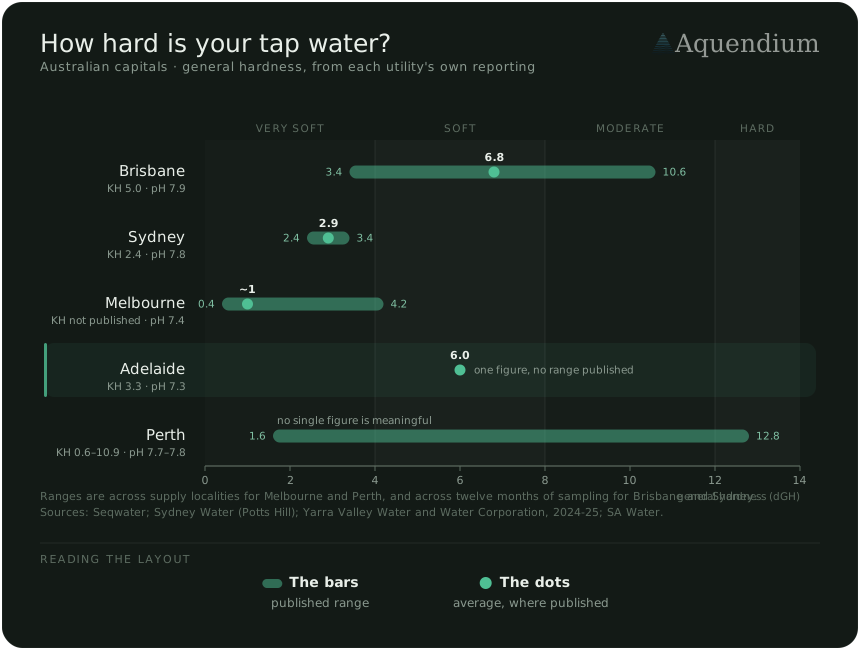
The gap between GH and KH
Adelaide's most useful characteristic for a fishkeeper is the relationship between its two hardness numbers, and it is a genuinely different profile from Brisbane's.
Adelaide runs 6.0 dGH against 3.3 dKH. Brisbane, with similar general hardness at 6.8 dGH, carries 5.0 dKH. So Adelaide has almost as much dissolved calcium and magnesium, but noticeably less carbonate to neutralise acid. That is why the pH sits at 7.3 rather than Brisbane's 7.9, and it is why an Adelaide tank drifts downward more readily than a Brisbane one.
This is not a problem, it is just a thing to know. It means:
- Water changes matter for stability, not just cleanliness. Each one restores buffering that the tank has consumed.
- Test KH occasionally, not just pH. KH falls first and gives you warning; pH falls once the buffer is gone.
- CO2 injection needs more care. With 3.3 dKH, injected CO2 moves the pH further and faster than it would in Brisbane. See our CO2 guide.
Chlorine, not chloramine
SA Water's profile shows free chlorine at 0.4 ppm with chloramine below 0.1, so Adelaide is chlorinated rather than chloraminated. That puts it with Melbourne and against Brisbane and Sydney.
Practically, chlorine evaporates from standing water, so a bucket left overnight, particularly with an airstone running, does become genuinely safer. That is not true in the chloraminated cities, where the same advice is useless. Even so, a dechlorinator is faster, works instantly, and takes the guesswork out of how long is long enough, so it remains the sensible default. Seachem Prime or API Tap Water Conditioner both handle it, dosed via our water conditioner calculator.
Dissolved salts and the River Murray
Adelaide's supply blends Mount Lofty Ranges reservoirs, the River Murray and desalinated water from Port Stanvac, and the Murray contribution shows up as higher total dissolved solids, around 311 ppm, with chloride near 90 ppm and sodium around 55 ppm. Brisbane, for comparison, runs closer to 290 ppm TDS with much of that being hardness rather than salts.
None of this harms fish at these levels. It has two practical consequences worth knowing. First, evaporation concentrates it: as water evaporates the salts stay behind, so always top up with fresh dechlorinated water rather than letting the level fall and refilling occasionally. Second, the Murray contribution is seasonal, so Adelaide's numbers move through the year more than a city drawing on a single protected catchment.
Fish that suit Adelaide water
At 6.0 dGH and pH 7.3, Adelaide sits comfortably in the middle of the range, which makes it easy water for a broad community tank.
- Community all-rounders are ideal. Corydoras, danios, barbs, gouramis, harlequin rasboras and most peaceful tetras are all comfortable here.
- Livebearers do well on the mineral content, though their ideal GH is a little above Adelaide's and the near-neutral pH is at the low end of what they prefer. Guppies and platies are fine; mollies appreciate a mineral top-up.
- Neocaridina shrimp such as cherry shrimp have enough GH to moult properly, which is more than can be said for Melbourne.
- Snails get adequate calcium for shell growth.
- Softer-water species including neon tetras manage well at 6 dGH and near-neutral pH, better than they would in Brisbane's more alkaline water.
The exception, as everywhere in Australia, is African rift lake cichlids, which want 10 dGH and above plus a high pH. Adelaide does not supply that, so remineralise with crushed coral, an aragonite substrate or a rift salt.
When to adjust it
For a community tank, no adjustment is needed. Adelaide water is middle-of-the-road in the ways that matter and suits a wide range of fish as it comes.
The case worth considering is raising KH slightly if your tank is heavily stocked, if you inject CO2, or if you have seen pH drift between water changes. A small amount of crushed coral in the filter lifts KH gently and self-regulates, and it will raise GH a little at the same time, which suits livebearers and snails. Beyond that, softening for a blackwater biotope means RO water and real ongoing work, and is rarely worth it given how workable the tap already is.
Zones, seasons and rainwater
Adelaide's blended supply means the numbers shift by zone and by season. Areas fed more from the Mount Lofty reservoirs, such as the Anstey Hill zone serving the north-east, tend to read softer and lower in dissolved solids than zones taking more River Murray water, and the balance changes with rainfall and reservoir levels through the year.
That variation does not change which fish suit Adelaide, since the whole range stays soft to moderate and near neutral. If you are breeding, keeping shrimp or running CO2, test your own tap. SA Water publishes a profile by address, which is the quickest way to see your own zone's figures.
Related reading: aquarium water parameters explained, best freshwater fish for Australian tap water, and aquarium water changes, or browse the species directory.