CO2 for the planted aquarium
Injecting CO2 is the single biggest lever in a planted tank. It is what separates a slow, hardy low-tech setup from a fast, lush, carpeted aquascape. It is also the most advanced part of the hobby, and the most dangerous: get it wrong and you can suffocate your fish. This guide covers whether you need it, the ways to add it, how a pressurised system fits together, and how to run it safely.
Published 29 June 2026 · Last updated 29 June 2026 · 16 min read
What CO2 does, and whether you need it
Plants are built from carbon, and they get it from the CO2 dissolved in your water. In a brightly lit tank, CO2 is usually the first thing to run short, so adding it takes the brake off growth: plants grow faster and denser, colours deepen, carpets fill in, and demanding species become possible at all.
But faster growth is a commitment, not a free upgrade. It also demands strong light and more fertiliser to keep pace, more frequent trimming and water changes, and careful, consistent dosing. Out of balance, CO2 causes more algae, not less.
A note on pH. Injected CO2 forms carbonic acid, so it lowers your pH while it is running, often by 0.5 to 1.0. This is normal and not harmful to fish as long as your carbonate hardness (KH) provides buffering and the change is gradual and repeats the same way each day. Do not chase the pH reading or try to correct it; the drop checker (below) is what you actually tune to. Our water parameters guide explains the pH and KH relationship.
Ways to add CO2
There are four ways to get carbon to your plants, from a full pressurised rig to a daily capful of liquid. Open each to compare.
Pressurised CO2
A refillable gas cylinder feeding CO2 through a regulator and diffuser into the tank, switched on and off by a solenoid on a timer. The proper way to run a high-tech planted tank.
Strengths
- Precise, stable, adjustable dosing, which is the key to avoiding algae
- Enough CO2 for any tank size, carpets, and demanding plants
- Cheap to run once set up; a cylinder lasts months
- Set-and-forget with a solenoid and a timer
Trade-offs
- The highest upfront cost (cylinder, regulator, diffuser, drop checker)
- More parts to assemble and understand
- The cylinder needs refilling periodically
- It can harm fish if overdosed, so it must be set up carefully
Liquid carbon
A bottled liquid (glutaraldehyde-based, such as Seachem Flourish Excel) dosed daily that gives plants a usable carbon source and some mild algae control. It is not dissolved CO2, and it is far weaker.
Strengths
- Cheap and simple, with no equipment to set up
- Doubles as an algae spot-treatment
- Fine for low-to-moderate-light tanks and easy plants
Trade-offs
- Much weaker than real CO2; it will not grow demanding plants or carpets
- Melts vallisneria, some mosses, and a few stem plants
- Harmful to shrimp and sensitive fish if overdosed
- An ongoing cost that adds up against a refillable cylinder over time
DIY yeast CO2
A sealed bottle of sugar, water, and yeast that ferments to produce CO2, piped into the tank through a diffuser. The budget entry point.
Strengths
- Very cheap to set up from household items
- A genuine source of real CO2, unlike liquid carbon
- A good way to learn the basics on a small tank
Trade-offs
- Output is inconsistent and fades over days, then you remix the bottle
- No on/off control, so it runs at night too, when plants cannot use it
- Fiddly and messy, and only enough for a nano or small tank
- The fluctuation it causes is itself an algae trigger
Disposable cartridge kits
A compact kit that runs off small disposable CO2 canisters, sold for nano aquascapes and desktop tanks.
Strengths
- Compact and tidy, with no large cylinder to house
- Real, controllable CO2 in a small footprint
- Good for a nano planted tank or a desk aquascape
Trade-offs
- Expensive per gram of CO2; the canisters run out fast
- Only practical for very small tanks
- The ongoing canister cost makes a refillable cylinder cheaper long-term
A pressurised CO2 system, part by part
A pressurised system is a chain of parts, each doing one job, running from the high-pressure cylinder down to the bubbles dissolving in your tank.
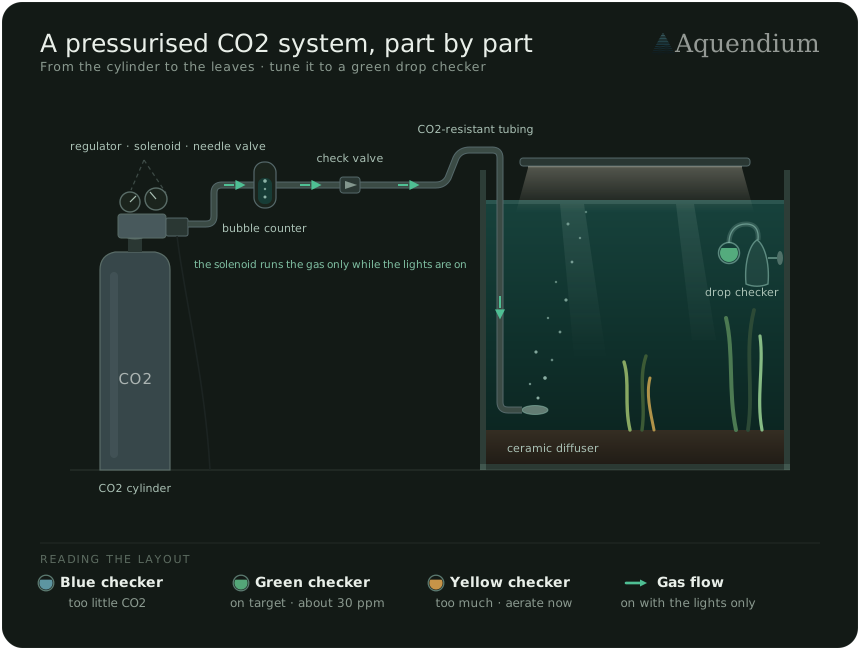
| Part | What it does | Need it? |
|---|---|---|
| CO2 cylinder | Stores the pressurised gas. Refillable is far cheaper than disposable long-term | Essential |
| Regulator | Steps the cylinder's high pressure down to a usable working pressure, with gauges | Essential |
| Solenoid valve | Switches the CO2 on and off with a timer, so it runs only while the lights are on | Strongly recommended |
| Needle valve | Fine-tunes the bubble rate. Usually built into a good regulator | Essential |
| Bubble counter | Lets you see and set the bubble rate | Recommended |
| Check valve | Stops tank water siphoning back up the line into the regulator | Essential |
| CO2-resistant tubing | Carries the gas. Ordinary airline degrades and leaks CO2 | Essential |
| Diffuser or reactor | Dissolves the CO2 into the water | Essential |
| Drop checker | Shows the dissolved CO2 level by colour, an hour or two behind real time | Strongly recommended |
The good news is that most of this comes together in one purchase: a CO2 regulator with a built-in solenoid and needle valve covers three parts at once, and many kits add a bubble counter, check valve, tubing, and diffuser. The choices that actually matter are these:
The cylinder. A refillable cylinder is much cheaper to run than disposable canisters, and bigger cylinders cost less per refill and need refilling less often. Size it to your tank and how often you want to lug it for a refill. Refilling options in Australia are covered below.
The regulator. Buy a dual-gauge regulator with a solenoid and needle valve included. The two gauges show cylinder pressure (how full it is) and working pressure (what is going to the tank). A quality regulator is the part worth spending on, because a cheap one is the main cause of the dangerous "end of tank dump" described under safety.
Diffuser or inline reactor. A ceramic-disc diffuser sits in the tank and breaks CO2 into a fine mist; it is cheap, simple, and good for small to medium tanks, though the mist is visible. An inline atomiser or reactor plumbs into a canister filter's return line, dissolves CO2 more efficiently, and stays out of sight, which suits larger or display aquascapes.
The drop checker. This small glass bulb holds a reference solution that changes colour with dissolved CO2: blue means too little, green means about right (the 30 ppm target), and yellow means too much. It lags real time by an hour or two, so read it as a daily trend, not a live gauge.
Dialling it in: drop checker, target, and timing
The target is roughly 30 ppm of dissolved CO2: enough for strong plant growth, while still safe for fish. You do not measure that directly; you watch the drop checker settle to green and watch your fish.
Start low and build up. Begin with a slow bubble rate, then increase it a little every couple of days until the drop checker holds green by mid-afternoon and the fish are behaving normally. It is far safer to creep up than to overshoot, so when in doubt, dose less.
Run it with the lights, not around the clock. Plants only use CO2 in the light, so put the solenoid on a timer: turn the CO2 on one to two hours before the lights come on, so the water is saturated when photosynthesis starts, and off an hour or two before lights-out. Running CO2 at night wastes gas and is dangerous for fish, because oxygen is already at its lowest then.
Keep oxygen up, especially overnight. CO2 and oxygen are a balance. Plants add oxygen by day, but at night they and the fish only consume it. Maintain some surface movement, or run an air stone overnight, so oxygen stays high while the CO2 is off. Good surface agitation also lets excess CO2 off-gas, which is a safety margin.
Bubble rate is a useful reference for repeating a setting, but tanks, diffusers, and flow all differ, so the drop checker and your fish are what you actually tune to.
CO2, light, and algae
Light, CO2, and nutrients are a triangle. Strong light drives fast growth, and that growth needs matching CO2 and fertiliser to keep up. When light outruns the CO2 available, algae fills the gap. This is why high-tech tanks get algae: not from too much CO2, but from too little or unstable CO2 relative to the light.
Consistency is everything. A CO2 level that swings around (the hallmark of DIY yeast, or a cylinder that quietly runs out) is a leading cause of black beard algae and other stubborn growth. A steady 30 ppm delivered the same way every day beats a level that spikes and crashes. See the algae guide for what each type is telling you.
Safety: CO2 can kill fish
CO2 is the one part of planted-tank keeping that can wipe out your livestock in a night, so it deserves real respect.
Mind the "end of tank dump". As a cylinder nears empty, a cheap or failing regulator can release a sudden slug of CO2 at high concentration, which can kill a tank overnight. A good-quality regulator greatly reduces this risk, and refilling before the cylinder runs fully out avoids the danger zone entirely.
Handle the cylinder properly. A CO2 cylinder is under high pressure. Keep it upright and secured so it cannot fall, store it away from heat, do not tamper with a charged regulator, and have refills and inspections done by a proper gas supplier. Treat it like the pressurised gas bottle it is.
Refilling and buying CO2 in Australia
Refilling is the real practical question. A pressurised setup is only as convenient as your refill option, so sort this out before you buy a cylinder. In Australia, the common routes are:
- Adapters that let you refill from, or run off, SodaStream bottles, paintball (CO2) tanks, or even a fire extinguisher. Handy for small to medium tanks.
- Beverage and welding gas suppliers, who sell or swap the same CO2 that pubs use for kegs. This is the cheapest way to keep a larger cylinder filled.
- Aquarium shops, some of which do cylinder swaps or refills, though availability varies by area.
For a permanent setup, a larger refillable cylinder paired with a local gas supplier is the cheapest long-run option by a wide margin.
Cylinder testing. Australian gas suppliers will only refill a cylinder that is within its inspection (hydrostatic test) date, so buy a cylinder that is in-test and keep it in-test. An out-of-test bottle is a paperweight until it is re-certified.
Brands and cost. Regulators, diffusers, drop checkers, and complete kits from CO2Art, Aquario, ISTA, and UP Aqua are sold through Australian aquarium shops and online stores. The kit is the main outlay; running cost is low, since a refill lasts months. Against buying liquid carbon forever, a pressurised rig pays for itself if you are committed to a high-tech tank. If you are not sure yet, start low-tech and add CO2 later.
CO2 is the high-tech step beyond planted tank basics. It works hand in hand with your lighting, and getting the balance wrong shows up as algae. Browse plants' tankmates in the species directory.