Types of aquarium algae and how to control them
Algae is not a disease and not a sign of failure. It is what grows when light and nutrients are available and nothing is using them up. This guide helps you identify which algae you have, understand what it is telling you, and bring the tank back into balance.
Published 21 June 2026 · Last updated 29 June 2026 · 17 min read
Why algae grows in the first place
Algae needs three things: light, nutrients, and a surface to grow on. Give it surplus light or surplus nutrients that your plants and fish are not using, and it will appear. This is not a flaw in your tank. It is biology doing exactly what it should.
The single most common trigger in home aquariums is light: a photoperiod that runs too long, lights brighter than the tank needs, or worst of all, direct sunlight falling on the glass. The second is nutrients, usually from overfeeding, overstocking, or a new tank that has not settled. Algae are opportunists. They bloom on whatever surplus is going.
Almost every new tank passes through an algae phase in its first two to three months, typically brown diatoms followed sometimes by a green stage, while the biology stabilises. This is normal and usually fades on its own. For the full picture of what is happening biologically in those early weeks, see our cycling guide.
Identify your algae
Open the section that matches what you are seeing. Each one covers what it looks like, what is driving it, and what to do about it. Correct identification matters: the harmless brown film in a new tank needs only patience, while a spreading cyanobacteria sheet needs action. If it is the water itself that has gone cloudy rather than a coating on surfaces, start with our cloudy and green water troubleshooter, which sorts white, brown and green water by colour.
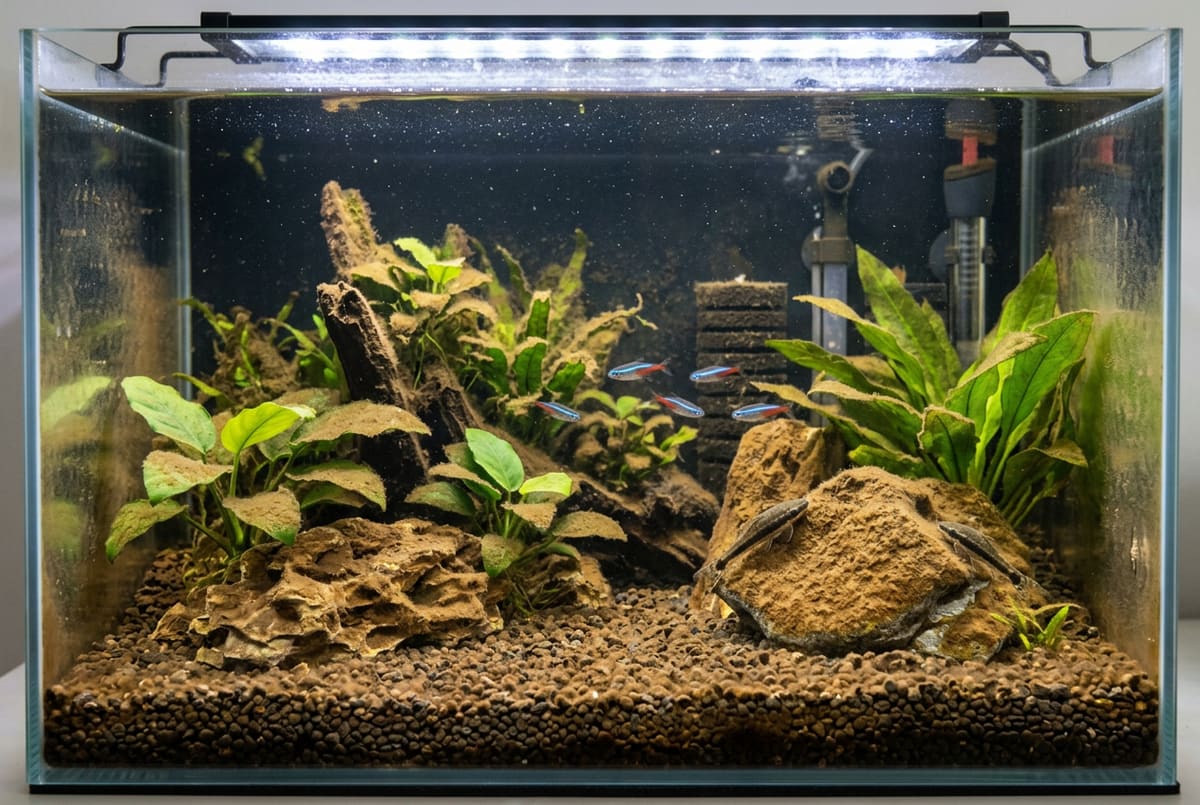
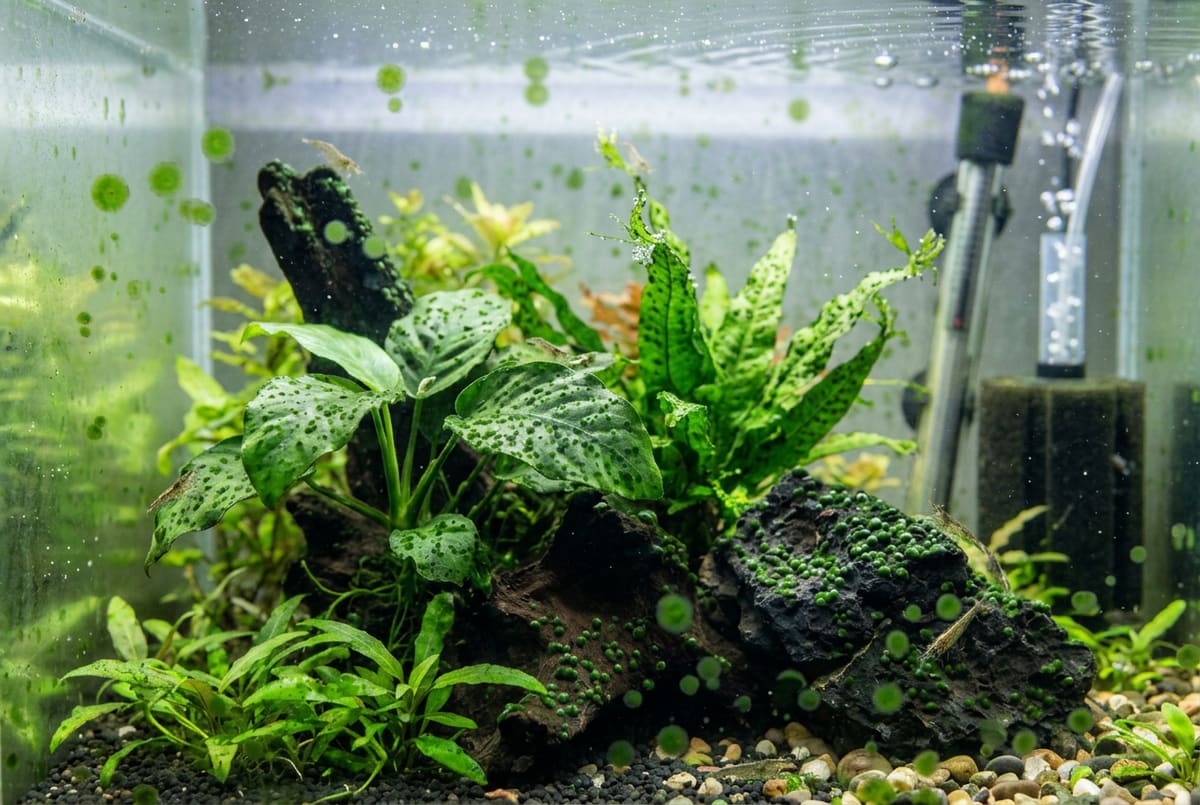
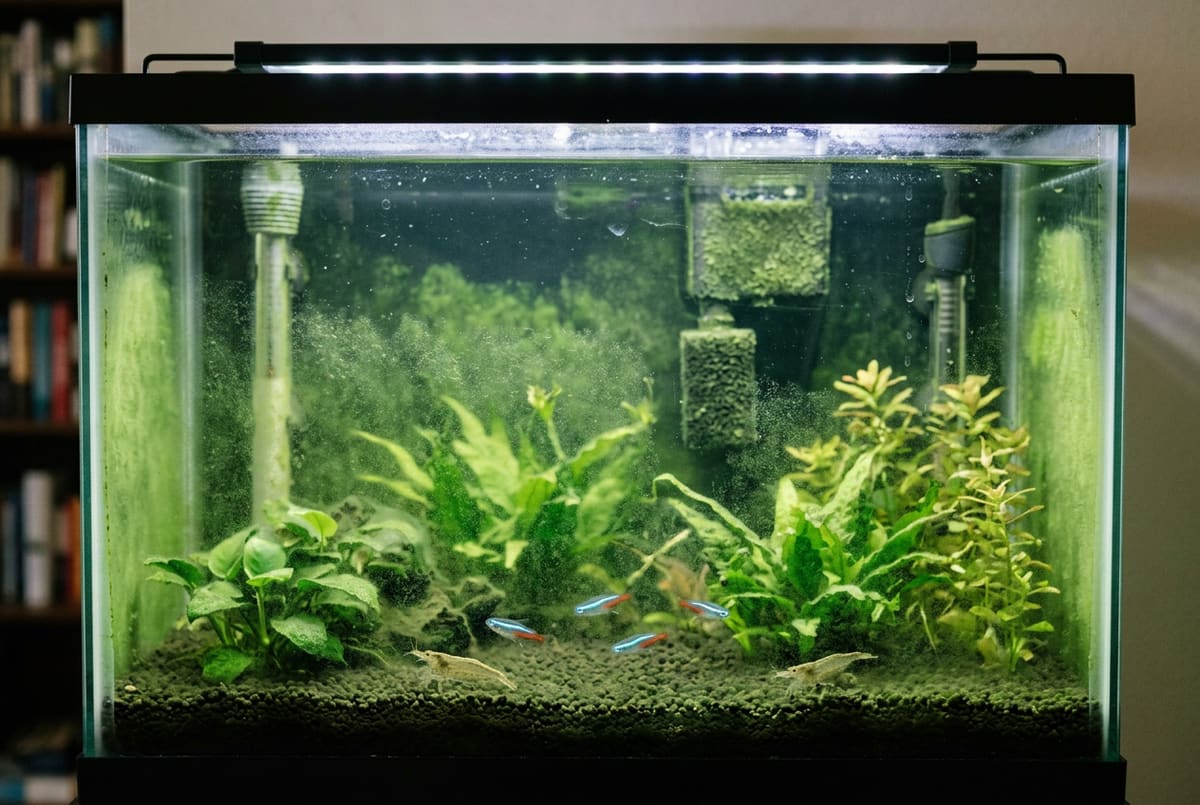
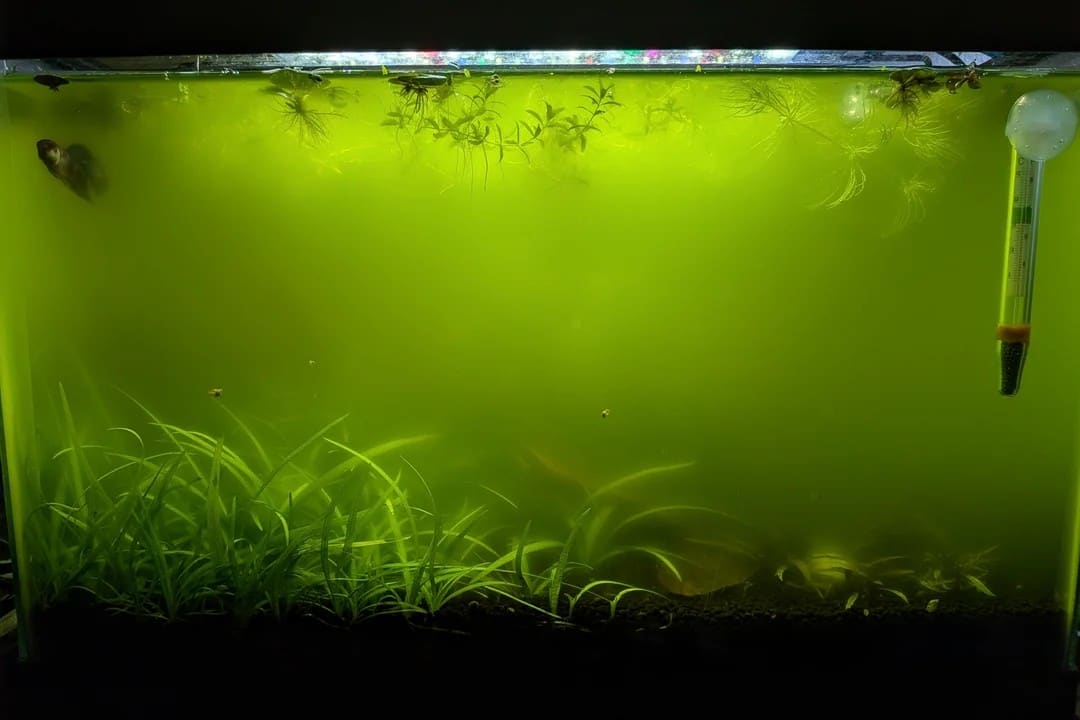
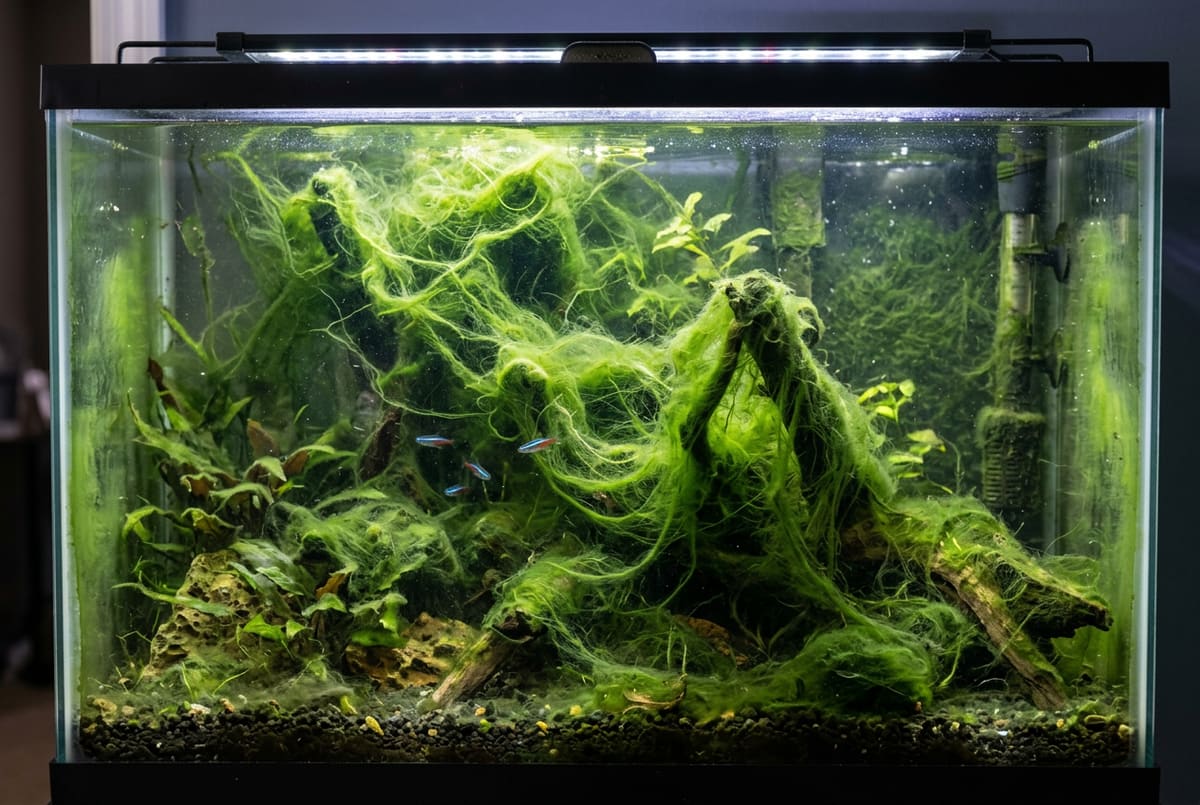
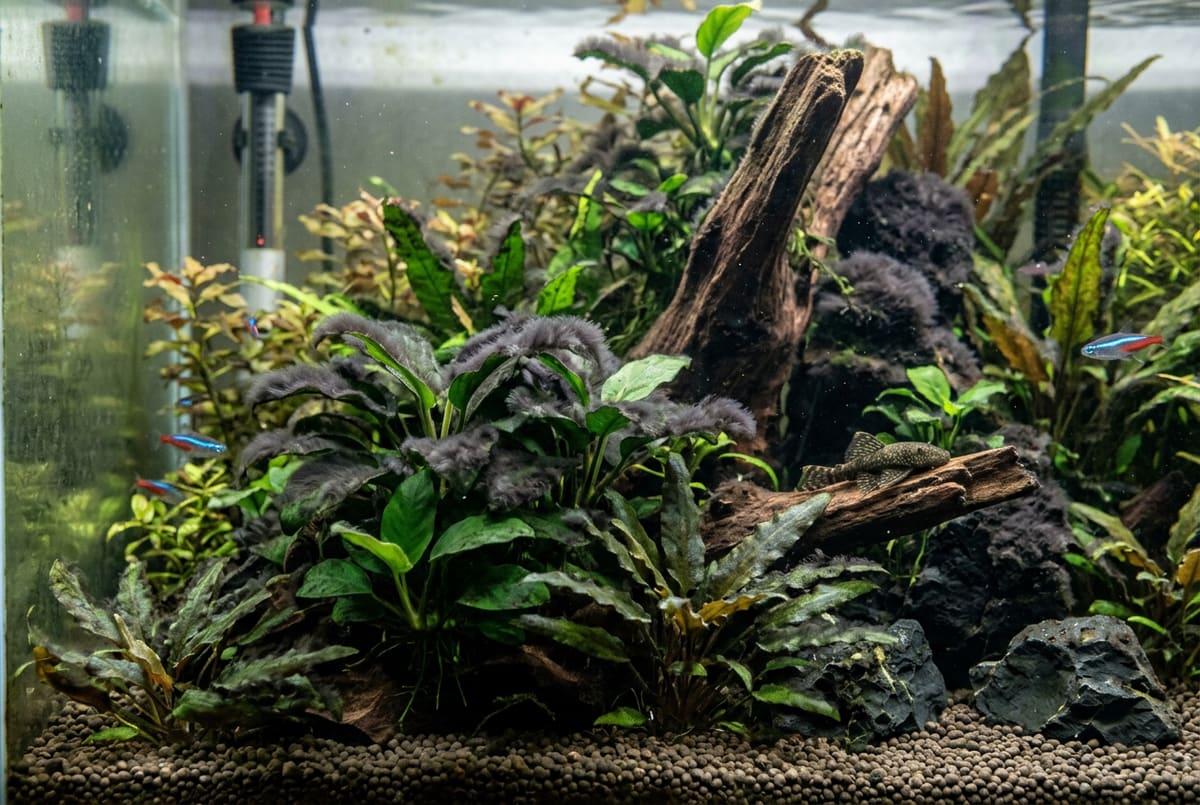
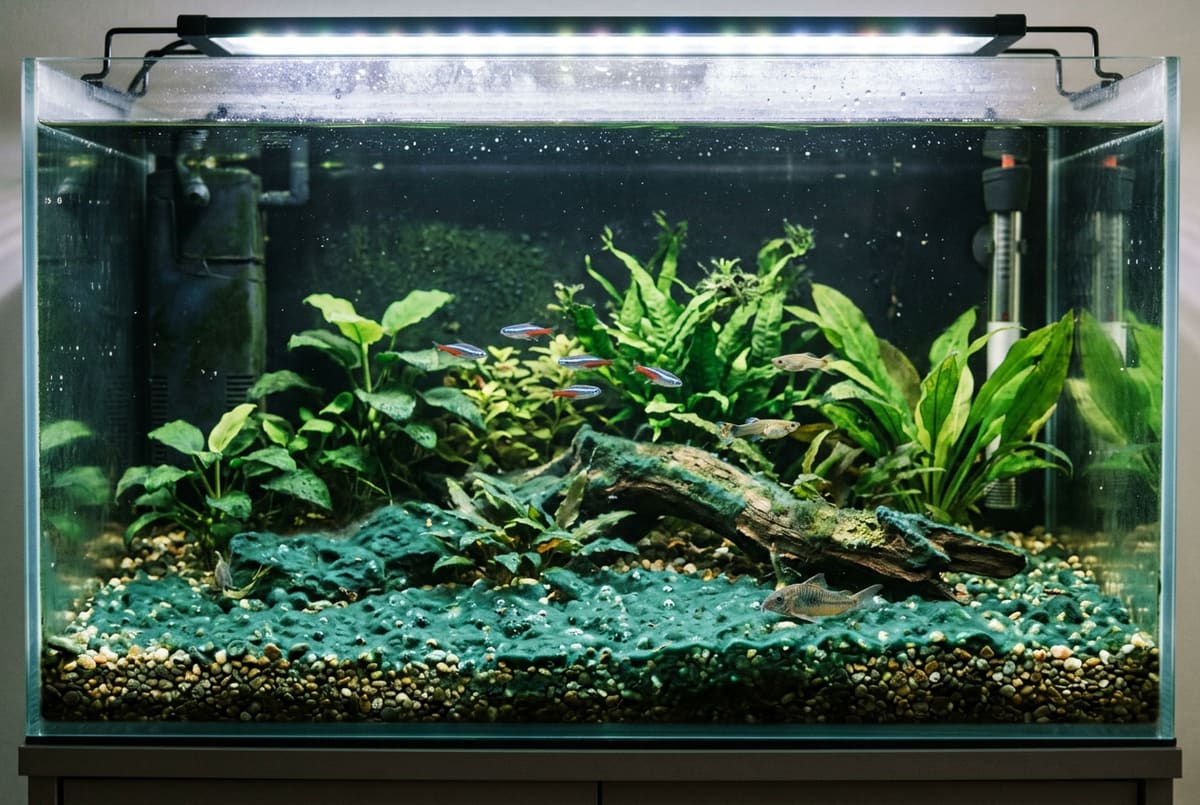
A brown or golden dusty film, usually in a new tank Likely diatoms
What you're seeing
A soft brown or tan dust coating the glass, substrate, leaves, and decor. It wipes away easily, leaving a clean streak behind, and it almost always appears in the first few weeks of a new tank.
What it is: diatoms (brown algae)
Diatoms are single-celled algae with silica shells. They thrive in young, not-yet-stable tanks with modest light and a supply of silicates (dissolved silica) leaching from new substrate, sand, or tap water. As the tank matures and the available silica is used up, they usually fade on their own.
What to do
Patience is the main treatment. Wipe the glass, siphon the worst off the substrate during your weekly water change, and keep your maintenance steady. Nerite snails graze diatoms readily. Otocinclus love them too, but hold off adding otos until the tank is genuinely established, because they need a mature tank rich in biofilm to survive.
Common mistake: Panicking and dosing chemicals. Diatoms in a new tank almost always clear within a few weeks with no intervention at all.
Small, hard green dots on the glass and on slow-growing leaves Likely green spot algae
What you're seeing
Tiny round green spots, firmly attached, that resist wiping with a soft cloth. They are most common on the glass and on the oldest leaves of slow plants such as anubias.
What it is: green spot algae (GSA)
A tough, disc-shaped algae associated with strong or long lighting combined with low phosphate. It is most stubborn in bright tanks where phosphate is being kept very low, which is a common state in lightly fed or sparsely stocked planted tanks.
What to do
Scrape the glass with a blade or a firm algae scraper; a soft pad will not shift it. On plant leaves it cannot be removed without tearing the leaf, so simply trim the worst-affected old leaves. In a planted tank, slightly raising phosphate and shortening the photoperiod reduces regrowth. Nerite snails are the one cleanup animal that reliably rasps green spot algae off glass.
Common mistake: Scrubbing harder with a soft sponge. Green spot algae needs a blade to remove, and the cause lies in your light duration and phosphate level.
A fine green film that coats the glass and regrows within days of wiping Likely green dust algae
What you're seeing
An even green haze over the glass, and sometimes the decor, that you can wipe off but which returns within a day or two. Unlike green spot algae, it is a soft film rather than hard dots.
What it is: green dust algae (GDA)
A film-forming algae with a life cycle of roughly three to four weeks. Wiping it off repeatedly just resets that cycle and keeps it going, which is why it feels impossible to beat by cleaning.
What to do
Counter-intuitively, leave the glass alone for about three to four weeks and let the algae complete its cycle and settle. Then wipe the glass thoroughly in one pass and do a large water change to remove the loosened spores. Shortening the photoperiod afterward helps prevent its return.
Common mistake: Wiping the glass every few days. This is the one algae where constant cleaning prolongs the problem rather than solving it.
The whole tank has turned cloudy green, like pea soup Likely a green water bloom
What you're seeing
The water itself turns green and murky, a haze through the entire water column rather than a coating on surfaces. It often appears quickly, sometimes seemingly overnight.
What it is: a green water bloom
A bloom of free-floating, single-celled algae. The trigger is almost always too much light (direct sunlight is the classic cause) together with surplus nutrients: an ammonia spike in a new or disturbed tank, overfeeding, or over-fertilising. It looks alarming but is harmless to fish.
What to do
Because the algae is suspended and reproducing rapidly, water changes alone rarely fix it; it regrows faster than you can dilute it. The two reliable cures are a complete blackout (cover the tank entirely for three to four days, with no light at all) or a UV steriliser, which clears a bloom within days and is the most dependable fix. Then remove the cause: move the tank out of direct sun, shorten the photoperiod, and stop overfeeding.
Common mistake: Doing daily large water changes and nothing else. Without removing the light and nutrients driving it, the bloom simply returns.
Green strands or soft fuzz growing on plants, wood, and equipment Likely hair, thread, or fuzz algae
What you're seeing
Soft green filaments, ranging from short fuzz along leaf edges to long stringy threads that wave in the current and wrap around plants and hardscape.
What it is: filamentous green algae
Hair, thread, and fuzz algae are closely related forms of filamentous green algae. They typically appear in brighter tanks where light and nutrients are out of balance, for example strong light paired with unstable CO2, or surplus nutrients that the plants are not keeping up with.
What to do
Remove it manually first: twirl long strands onto an old toothbrush, like spaghetti onto a fork. Then rebalance the tank: reduce the light duration, keep nutrients and (in high-light tanks) CO2 stable, and improve plant health so the plants outcompete it. Amano shrimp are the standout grazer here and one of the few animals that genuinely eat hair algae; cherry shrimp help in smaller tanks. See our guide to keeping freshwater shrimp.
Common mistake: Adding more light or fertiliser to "boost the plants" without first removing the algae and rebalancing. The extra input feeds the algae just as readily as the plants.
Dark, bristly tufts on leaf edges, wood, and filter outlets Likely black beard (or staghorn) algae
What you're seeing
Dense dark grey to black tufts, soft and slippery when wet, growing on the edges of slow leaves, on driftwood, and especially in high-flow spots like the filter outlet. Staghorn algae is a close relative: greyer, and branching like tiny antlers.
What it is: black beard algae (BBA)
Despite its appearance, black beard algae is a red algae. It is strongly associated with unstable or low CO2 and with fluctuating, organic-heavy conditions. It tends to take hold in tanks with inconsistent CO2, irregular maintenance, or a build-up of dissolved organic waste.
What to do
Stabilise conditions first: consistent water changes to lower organics, steady CO2 if you inject it, and a regular light schedule. For existing growth, spot-treat it. With the filter and flow turned off, dab the affected areas with a liquid carbon product (Seachem Flourish Excel) or carefully apply 3% household hydrogen peroxide, then restart equipment after a few minutes. Removable wood and rocks can be taken out and treated more thoroughly. The true siamese algae eater is one of the very few fish that eats black beard algae, particularly as a juvenile, so be sure you are buying the genuine species and not a look-alike.
Common mistake: Treating the visible algae while leaving the underlying cause (swinging CO2, organic build-up) unchanged, so it returns faster than any fish can eat it.
A slimy blue-green or dark sheet that peels off and smells musty Likely blue-green algae (cyanobacteria)
What you're seeing
A slimy, sheet-like film, blue-green to dark green and sometimes reddish, that spreads over the substrate, glass, and plants and peels away in slimy mats. The giveaway is a strong musty, earthy, swampy smell.
What it is: cyanobacteria
Despite the name, this is not an algae at all but a photosynthetic bacterium. It typically appears where nitrate is very low (often reading near zero), water flow is poor with stagnant dead spots, and organic waste has accumulated in the substrate, usually with strong light as well.
What to do
Siphon and manually remove as much as you can, improve flow to clear the dead spots, clean the substrate, and address the nutrient imbalance. A tank reading zero nitrate often does better with a little nitrate present. A three to four day blackout knocks it back because it is light-sensitive. As a last resort, an erythromycin-based treatment is effective, but it can affect your biological filter, and that antibiotic is vet-restricted in Australia (see our diseases guide). No fish or snail will eat cyanobacteria.
Common mistake: Treating it like ordinary algae and waiting for a cleanup crew to deal with it. Nothing grazes cyanobacteria. Flow, cleanliness, and a sensible nutrient balance are the fix.
Fixing algae at the source
Identifying the algae tells you the specific lever to pull, but a handful of general moves resolve or prevent most algae regardless of type. Work through them in order.
Control the light
This is the lever most keepers underuse. Reduce the photoperiod to 6 to 8 hours on a timer so it is consistent every day. Move the tank away from windows and direct sun. If your light is very bright and the tank is not heavily planted, raise it or dim it. Very old fluorescent tubes shift in spectrum as they age and can favour algae, so replace them on schedule. Our aquarium lighting guide covers photoperiod, intensity, and choosing a light in full.
Fix the nutrient balance
Algae feeds on surplus nutrients, so the goal is to stop the surplus. Avoid overfeeding, which is the biggest hidden nutrient source in most tanks, and do not overstock (check your level with the stocking calculator). Keep nitrate in a sensible band with regular water changes. In a planted tank the goal is balance, not zero: plants need some nitrate and phosphate, and starving a tank to zero often backfires with green spot algae or cyanobacteria. Our water parameters guide covers what each reading means.
Grow more plants
Fast-growing plants are the best long-term algae control there is. Floating plants and quick stem plants compete with algae for the very same light and nutrients, and a heavily planted tank rarely has a serious algae problem. If your tank is sparsely planted, adding more live plants does more for algae than any product. If you're not sure how densely planted your tank already is, the planting density calculator can help you estimate this from a photo.
Improve flow and maintenance
Stagnant spots and accumulated waste feed algae, black beard algae and cyanobacteria especially. Keep reasonable circulation throughout the tank with no dead corners, clean your filter regularly (rinsing media only in old tank water, never under the tap), and stay consistent with water changes. Consistency matters more than intensity.
Remove what you can, then let the crew graze
Physically remove algae each week (scrape glass, pull strands, siphon loose debris), and let an appropriate cleanup crew keep surfaces grazed between cleans. The crew is a maintenance tool, covered next. It manages algae; it does not cure the imbalance that causes it.
Algaecides such as API Algaefix can knock back a bloom, but they treat the symptom rather than the cause. If you use one at all, use it to buy time while you fix the light and nutrients, never as a substitute for doing so.
Algae-eaters that actually work
A cleanup crew is genuinely useful, but it is a maintenance tool, not a cure. Match the animal to the algae you actually have, and remember that some of the most common problems (green water, cyanobacteria) cannot be grazed by anything.
| Algae or job | Best grazers | Reality check |
|---|---|---|
| Brown algae (diatoms) | Nerite snails, otocinclus | Usually clears itself; add otos only once the tank is mature |
| Green spot algae | Nerite snails | The only animal that reliably rasps it off glass; nothing removes it from leaves cleanly |
| General green film and soft algae | Nerite snails, mystery snails, bristlenose pleco | Bristlenose suits larger tanks (80 L and up) and needs driftwood in its diet |
| Hair, thread, and fuzz algae | Amano shrimp, cherry shrimp | Amano is the standout; both are killed by copper-based medications |
| Black beard algae | Siamese algae eater (true species) | Few fish touch it; identify carefully, and juveniles eat the most |
| Green water (bloom) | None | Free-floating, so nothing grazes it; use a UV steriliser or blackout |
| Blue-green algae (cyanobacteria) | None | It is a bacterium; fix flow, nutrients, and cleanliness instead |
One more honest point: once a cleanup crew has done its job and the algae is gone, those animals still need to eat. Otocinclus and nerite snails can slowly starve in a spotless tank, so supplement them with algae wafers and blanched vegetables such as zucchini. The same "clean" tank you are aiming for is the one that starves them, which is why a crew works best alongside, not instead of, the fixes above.
Cold water and goldfish tanks
Unheated and cold water tanks, goldfish setups in particular, are often the most algae-prone tanks of all. The reasons compound: goldfish produce a heavy bioload (so plenty of nutrients), they are messy eaters, and they dig up and eat live plants, which removes your best natural algae control. Their tanks are also frequently placed in bright rooms or near windows. The usual result is green water and heavy green algae on every surface.
The catch is that most popular algae-eaters are tropical. Otocinclus, amano shrimp, siamese algae eaters, and nerite snails all prefer warmth and are not suited to a cold goldfish tank. Goldfish will also eat small shrimp and harass snails. There is no neat cleanup crew for a goldfish tank.
So in cold water the work shifts to you. Manage light hardest of all: keep the tank off the windowsill and out of direct sun, and run a short photoperiod on a timer. Feed sparingly, because uneaten food is pure algae fuel. Filter and change water generously to match the bioload (goldfish need far more of both than tropical fish of the same size). Clean surfaces by hand each week. Goldfish themselves graze a little algae, which helps at the margins. Our goldfish care guide covers the oversized filtration and larger water changes a goldfish bioload calls for.
For temperate tanks that are cool but not goldfish tanks, there are a few genuine cool-water grazers. Hillstream loaches graze biofilm and soft algae off rocks and glass and actually prefer cool, fast-flowing, oxygen-rich water (around 18 to 24°C). They pair well with the kind of fish that suit an unheated temperate tank, such as white cloud mountain minnows or rosy barbs. They are not goldfish tankmates (goldfish are too boisterous and their water too warm and rich), but they suit a cooler, cleaner setup well.
Australian context
Sunlight is stronger than you think. Australian light is intense, and a tank near a window or in a bright room receives far more light than most keepers expect, especially through summer. Repositioning the tank away from direct sun is the single highest-impact change many Australian keepers can make against algae.
Summer heat. Australian summers push tank temperatures up, and warmer water speeds algae growth and can tip a tank into a bloom. Shading the tank from afternoon sun and keeping the temperature stable both help through the hottest months.
Alkaline, mineral-rich tap water. Brisbane, the Gold Coast, Adelaide, and Perth have alkaline, mineral-rich water. This favours some algae such as green spot algae, and it suits nerite snails, which need that calcium for healthy shells. Soft-water Melbourne tanks behave differently. Our water parameters guide covers regional tap water profiles in detail.
Product availability. Liquid carbon (Seachem Flourish Excel), 3% hydrogen peroxide (from any supermarket or pharmacy), UV sterilisers, and algaecides such as API Algaefix are all readily available through Petbarn, Petstock, and dedicated aquarium shops. The exception is erythromycin, the antibiotic often recommended overseas for cyanobacteria, which is vet-restricted here, as covered in our diseases guide.
Test what feeds algae. A nitrate reading from the API Freshwater Master Test Kit, plus a separate phosphate test, tells you whether surplus nutrients are driving the problem or whether your tank has swung too far the other way to near zero.
When a little algae is fine
A spotless, algae-free tank is neither the goal nor realistic. A thin film of algae on the back glass, on rocks, and on older leaves is normal and even healthy. It is food for grazers and a sign of an established, living system. Many keepers deliberately let the back and side glass grow a soft green coat and clean only the front pane.
The tank to worry about is the one going backwards: a sudden bloom, black beard algae spreading quickly, or a smelly cyanobacteria sheet creeping across the substrate. Those are signals to check your light, nutrients, and flow, in that order.
Chasing zero algae usually does more harm than good, through starving the tank of nutrients or over-dosing chemicals. Aim for balance and consistency instead. A mature, well-planted, sensibly-lit tank settles into a low, stable level of algae that largely looks after itself.
To get the underlying conditions right, see water parameters explained, aquarium water changes, and the cycling guide for what happens in a tank's first months. Browse algae-grazing species in the species directory.