Aquarium lighting explained
Lighting is the most over-thought and under-managed piece of aquarium gear. Fish barely need it, plants live and die by it, and algae feeds on whatever is left over. Get it right and your tank looks its best and stays balanced. Get it wrong and you are either starving your plants or fighting algae for months. This guide covers what aquarium light is for, how much your tank actually needs, what the numbers mean, and how to choose and run an LED.
Published 23 June 2026 · Last updated 23 June 2026 · 14 min read
What aquarium light is actually for
Light in an aquarium does three jobs, and only one of them is about the fish.
- It lets you (and the fish) see. Fish need a regular day and night cycle, not brightness. They have no need for a strong light, and many species are happiest in subdued lighting with some shade.
- It powers plants. Live plants photosynthesise, so for them light is food. A planted tank's whole balance is built around how much light it gets.
- It feeds algae. This is the catch. Algae grows on surplus light and nutrients that nothing else is using, so your lighting choices are also your main algae control.
That leads to the single most useful idea in aquarium lighting: light is the accelerator, not the goal. In a planted tank, light has to be balanced against carbon dioxide and nutrients. Turn the light up without supplying the other two and the plants cannot use the extra, so the algae does instead. More light is not more growth; past a point it is just more algae.
Fish-only vs planted: how much light you need
How much light you need comes down to one question: are you growing plants, and how demanding are they? There are three broad cases.
Fish-only tanks
If you are not growing live plants, light is purely for viewing and to give the fish a day and night rhythm. Almost any basic LED on a timer does the job, and running it dimmer and for fewer hours simply means less algae. Do not buy a high-output "plant" light for a fish-only tank; it only adds cost and algae risk with no benefit. Shy or colourful species from shaded waters, such as chili rasboras and ember tetras, often look and behave their best under softer light with floating plants for cover.
Low-tech planted tanks
This is where most planted tanks should start: hardy, low-to-moderate-light plants like anubias, java fern, and cryptocoryne, grown under a modest light with a little fertiliser and no injected carbon dioxide. The light that came with your tank is often enough to begin. Our planted tank basics guide covers the plants and fertiliser side; the key lighting rule is restraint, because over-lighting a low-tech tank just grows algae the plants cannot outpace.
High-tech planted tanks
Demanding carpets, fast stems, and deep-red plants need strong light, but only alongside pressurised carbon dioxide and full fertiliser dosing. Here the three have to move together. Strong light with weak carbon dioxide or nutrients is the classic recipe for an algae outbreak, so high light is a commitment to the whole system, not a shortcut to better plants.
| Tank type | Light needed | Approach | Algae risk |
|---|---|---|---|
| Fish-only | Low | Basic LED, 6 to 8 hours on a timer | Low: keep it dim and short |
| Low-tech planted | Low to medium | Modest LED, hardy plants, a little fertiliser | Moderate if over-lit |
| High-tech planted | Medium to high | Strong LED, balanced with CO2 and dosing | High if light outruns CO2 and nutrients |
| Cold-water / goldfish | Low | Basic LED, short photoperiod | High by default, so light control does the work |
Reading the numbers: PAR, Kelvin, lumens, watts
Light is sold with a confusing spread of numbers, and most of them matter less than the marketing suggests. Here is what each one actually tells you.
PAR: the measure that matters for plants
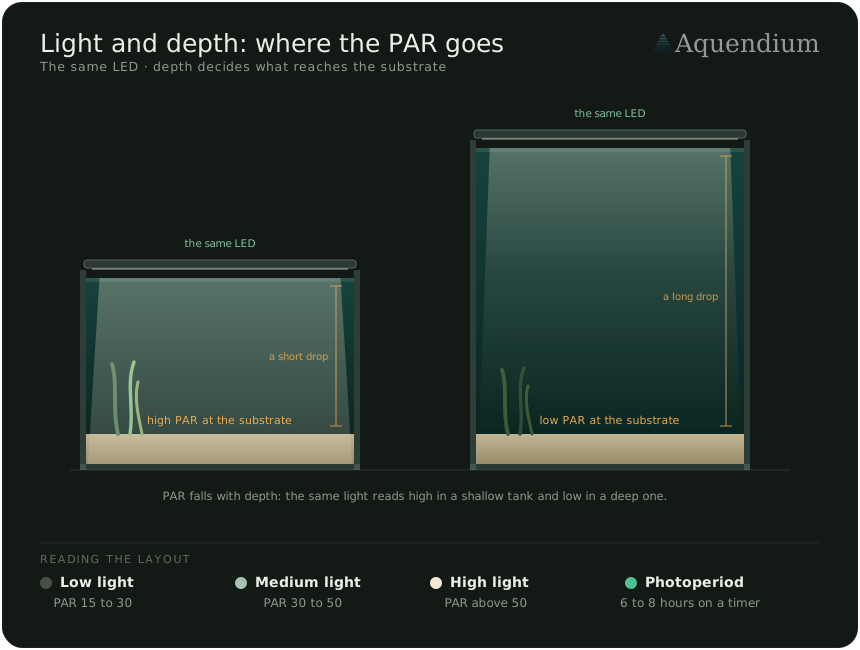
PAR (photosynthetically active radiation) measures the amount of usable light actually reaching a point in the tank, which is what plants respond to. As a rough guide, low light is around 15 to 30, medium 30 to 50, and high above 50, measured at the substrate. The catch is that PAR falls off with depth and spreads with distance, so the same light gives high PAR in a shallow tank and low PAR at the bottom of a deep one. Manufacturers increasingly publish PAR charts at different depths, which are far more useful than wattage. Measuring it precisely needs a PAR meter, which is overkill for most keepers, so treat the maker's figures and your plants' behaviour as your guide.
Colour temperature (Kelvin): how the light looks
Kelvin describes the colour of the light, from warm and yellow at the low end to cool and blue at the high end. For a freshwater tank, somewhere around 6500 to 7000K (daylight) is the sweet spot: it grows plants well and shows greens and natural fish colours faithfully. Below about 5000K the tank looks yellow and dull; above about 10000K it turns blue, which suits marine tanks but makes a freshwater tank look cold. Many modern LEDs use adjustable red, green, and blue (RGB) channels so you can tune the look, but a simple daylight-white light around 6500K is a reliable default.
Lumens and watts: weak proxies
Lumens measure brightness as the human eye sees it, not the light plants use, so they are only a rough proxy for plant growth. Watts measure power draw, not output. The old "watts per gallon" rule belongs to the fluorescent era: modern LEDs produce far more usable light per watt than the old tubes that rule was based on, so a low-wattage LED can easily outperform a high-wattage fluorescent. Ignore watts per gallon entirely, and treat lumens as a loose comparison between similar lights rather than a target.
Spectrum: which colours the light contains
Plants use red and blue light most heavily, which is why dedicated "plant" lights often push those bands and can look pink or purple. A good full-spectrum daylight-white LED already contains plenty of red and blue, grows plants well, and looks natural, so you do not need a purple grow-light to keep a healthy planted tank. Heavy blue light in particular tends to favour algae, so if you have an RGB light and an algae problem, easing back the blue channel is one useful lever.
Photoperiod: how long to leave the light on
The photoperiod is simply how many hours a day your light is on, and it is the most powerful, most underused setting you have. For almost every tank, 6 to 8 hours a day is the right range. Fish-only tanks can sit at the lower end, or even less if you only want the light on while you are watching the tank. High-tech planted tanks can push toward 8 hours, but every extra hour is also extra algae risk.
The most important part is consistency. Put the light on a plug-in timer, or use the scheduler built into the light, so it comes on and off at the same time every day without you thinking about it. Fish settle into the rhythm, and plants do best with a steady cycle. A light switched on and off by hand, at random times, helps neither.
A few finer points:
- Give the tank a real dark period. Fish need night as much as day. Running the light all day "so the fish can see" stresses them and feeds algae. Twelve or more hours of darkness is normal and healthy.
- Sunrise and sunset ramping is gentler. Many LEDs fade in and out over several minutes rather than snapping on. It is easier on the fish than a sudden blaze of light, and it looks better.
- The "siesta" method is optional. Splitting the photoperiod into two blocks with a dark break in the middle is a popular trick that can let carbon dioxide recover in high-tech tanks. The evidence is mixed, and for a beginner a single consistent block is simpler and works fine.
Choosing an LED
For a new tank there is really only one choice of technology. LEDs have replaced the old fluorescent tubes for good reason: they use less power, run cool, last for years, and can be dimmed, scheduled, and colour-tuned in ways tubes never could. The only question is which LED, and that follows from the tank you are lighting.
Match it to the tank first
Before features, get the basics right. Buy a light that spans the length of your tank, so the whole tank is lit evenly rather than leaving dark ends. Then match the power to the tank's depth: a tall tank needs a stronger light to push usable light (PAR) down to the substrate, while a shallow tank needs much less. If you do not know your tank's real dimensions, the tank volume calculator is a quick way to get them.
The features worth paying for
- A built-in timer or scheduler, or at least compatibility with a plug-in timer, so the photoperiod runs itself.
- Dimmability. The single most useful feature. Being able to turn the light down lets you dial in plant growth and back off the moment algae appears, without buying a new light.
- Sunrise and sunset ramping, for a gentler cycle and a better-looking tank.
- A daylight spectrum around 6500K, or adjustable RGB, for natural colour and good plant growth.
- Solid mounting, adjustable legs or brackets that fit your tank, especially for a rimless tank where a hood will not sit.
What to skip or be wary of
- Over-powered lights on a beginner tank. A high-output planted light over a fish-only or low-tech tank is an algae problem waiting to happen.
- Cheap unbranded lights. Poor, often blue-heavy spectrum, no dimming, and, in Australia, frequently no proper 240V certification. Not worth the saving.
- Gimmick modes. Disco colour cycles and flashing effects are harmless fun but not a reason to choose a light, and a constant blue "moonlight" left on overnight can disturb fish and feed algae.
Recommended lights by use case
These are widely available in Australia and cover the range from a first fish tank to a serious planted setup.
Most of these lights come in several lengths, each with extendable brackets that cover a range of tank sizes (one size of the Fluval Plant 4.0, for example, fits tanks 59 to 89 cm long). Measure your tank before buying and choose the size whose range includes its length, so the light reaches both ends without overhanging them.
| Use case | Light level | Good picks | Notes |
|---|---|---|---|
| Fish-only / community | Low | Aqua One, Fluval Aquasky, NICREW | A basic daylight LED on a timer is all you need. Dimmer and shorter means less algae. |
| Low-tech planted | Low to medium | Fluval Plant 4.0, Chihiros WRGB II | Choose a dimmable model so you can start gently. The light that came with the tank is often enough at first. |
| High-tech planted | Medium to high | Fluval Plant 4.0, Chihiros WRGB II, Twinstar | The output only pays off with CO2 and full dosing. Without them it simply grows algae. |
Mounting, timers, and upkeep
A light is only as good as the way it is set up and kept. A few habits make all the difference.
Mount it for even coverage, and use height as a control. Most lights sit on adjustable legs across the rim, in an integrated hood, or hung above a rimless tank. Raising a light spreads and softens it (less PAR at the substrate), while lowering it concentrates and strengthens it. That makes mounting height a free intensity dial: if a fixed-output light is too strong and feeding algae, raising it is an easy fix.
Put it on a timer from day one. A cheap plug-in timer or the light's own scheduler keeps the photoperiod consistent and removes the most common cause of algae, a light left on too long. This is the highest-value few dollars you will spend on the tank.
Keep the light and cover clean. A film of dried mineral spots on the cover glass or the underside of the light quietly cuts the light reaching the tank. Wiping it down is part of the monthly routine in our maintenance schedule, and it matters more in hard-water parts of Australia where that film builds up fast.
Replace lighting on the right schedule. A good LED dims so slowly over years that you will rarely need to replace it, and it does not shift colour the way old tubes did. If you have inherited a tank running fluorescent tubes, note that tubes lose output and drift in spectrum as they age, which can quietly start favouring algae, so replace them on the maker's schedule rather than waiting for them to fail.
Australian context
A few things are worth knowing for setting up lighting in Australia specifically.
Buy 240V-certified gear. Any light sold through a reputable Australian aquarium retailer is built and certified for 240V mains. Avoid cheap imports from overseas marketplaces that may not be electrically safe; water and mains electricity is not the place to save a few dollars. Brands stocked widely here include Fluval, the Australian house brand Aqua One, and the planted-tank favourites Chihiros and Twinstar.
Mind the sun. Australian rooms can be very bright, and a tank that catches direct sun for even an hour a day will struggle with algae no matter how carefully you set the artificial light. Place the tank away from north and west-facing windows where you can, and use blinds or the tank's position to keep direct sun off the glass. This matters more here than in dimmer climates.
Minerals show on the glass. In mineral-rich regions like Brisbane, the Gold Coast, Adelaide, and Perth, evaporation leaves a mineral film on cover glass and light lenses that cuts output over time. A quick monthly wipe keeps the light you paid for actually reaching the tank.
Light is one piece of a balanced tank. See our guides on planted tank basics, aquarium algae and how to control it, and the maintenance schedule, or browse the species directory for the fish that suit your setup.