Perth tap water for aquariums
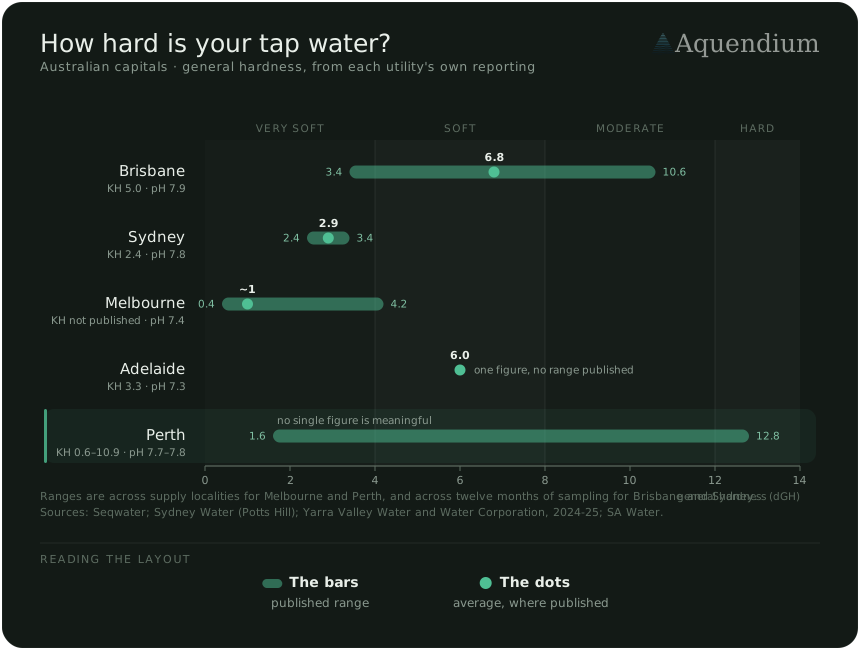
Perth is the one Australian capital where a single city-wide water figure is genuinely useless. Water Corporation's own testing shows hardness ranging from 29 mg/L at Dwellingup to 228 at Two Rocks, an eightfold spread across the one supply network. A Mandurah tank and a Two Rocks tank are keeping different water. Perth is also the only place in urban Australia where the tap delivers water hard enough for African rift cichlids without help. So this page is organised the way Perth actually works: find your locality, then read what it means.
Published 29 July 2026 · Last updated 29 July 2026 · 10 min read
Hardness and KH by locality
These are Water Corporation's published means for 2024-25, converted at the standard 1 dGH = 17.86 ppm using our hardness converter. They are supply localities rather than suburbs, so find the one nearest you geographically.
| Locality | GH | KH | Band |
|---|---|---|---|
| Dwellingup | 1.6 dGH | 0.6 dKH | Very soft |
| North Dandalup | 2.4 | 2.0 | Very soft |
| Pinjarra | 2.6 | 2.3 | Very soft |
| Tamworth Hill | 2.6 | 2.5 | Very soft |
| Hills Direct | 2.7 | 2.2 | Very soft |
| Bold Park | 2.7 | 2.5 | Very soft |
| Mandurah | 2.8 | 2.7 | Very soft |
| Melville | 3.0 | 3.3 | Very soft |
| Hamilton Hill | 3.1 | 2.7 | Very soft |
| Mt. Eliza | 3.2 | 3.1 | Very soft |
| Buckland Hill | 3.5 | 3.6 | Very soft |
| Armadale / Kelmscott | 4.2 | 3.2 | Soft |
| Foothills | 4.2 | 3.5 | Soft |
| Greenmount / Darlington | 4.3 | 4.0 | Soft |
| Thomsons Lake | 5.0 | 4.3 | Soft |
| South Perth / Kewdale | 5.3 | 6.0 | Soft |
| Greenmount | 5.3 | 5.9 | Soft |
| Mundaring | 5.5 | 3.8 | Soft |
| Mt. Hawthorn | 5.9 | 7.1 | Soft |
| Mt. Yokine | 6.0 | 6.7 | Soft |
| Whitfords | 6.3 | 4.5 | Soft |
| Lexia | 6.6 | 3.6 | Soft |
| West Yokine | 6.9 | 4.8 | Soft |
| Mirrabooka | 6.9 | 3.2 | Soft |
| Wanneroo | 7.0 | 6.0 | Soft |
| Neerabup | 10.6 | 8.7 | Moderate |
| Yanchep | 11.1 | Not published | Moderate |
| Two Rocks | 12.8 | 10.9 | Hard |
Perth's pH sits around 7.7 to 7.8 across the localities Water Corporation reports it for, so alkaline everywhere regardless of hardness.
Why Perth varies so much
The spread is not inconsistency, it is the supply structure. Perth's Integrated Water Supply Scheme blends four quite different sources, and in 2023-24 the mix was roughly 45% groundwater, 36% desalinated seawater, 19% surface water from the hills dams, and a small amount of groundwater replenishment.
Those sources have completely different mineral content:
- Hills dam water is very soft. Dwellingup at 1.6 dGH is essentially rainwater off a catchment.
- Desalinated seawater is low in hardness after treatment, remineralised only enough to stop it corroding pipes.
- Groundwater from the coastal limestone is the mineral source. The Gnangara mound in the north sits in limestone, and water drawn through it picks up a lot of calcium. That is why the northern corridor is hard and the hills are not.
Which blend reaches your tap depends on geography and on what the scheme is doing that season. It is why a single "Perth" number would mislead even if someone published one.
What your numbers mean
Once you know your GH, here is where you sit on the aquarium scale, which is not the same as the plumbing scale filter companies use.
| Your GH | Band | What it means for stocking |
|---|---|---|
| Under 4 dGH | Very soft | Excellent for tetras, rasboras and dwarf cichlids. Add minerals for livebearers, snails and shrimp |
| 4 to 8 dGH | Soft | Broad community range, much like Brisbane. Very forgiving |
| 8 to 12 dGH | Moderate | Livebearers, rainbowfish and snails excellent. Rift cichlids become viable |
| Above 12 dGH | Hard | Ideal for rift cichlids. Soft-water species need RO to be comfortable |
Check KH at the same time, because it decides how steady your pH will be. Above about 4 dKH your pH will sit firmly and forgive lapses in maintenance. Below 3 dKH, and much of southern Perth is below 3, keep up with water changes because there is less holding it in place. Our water parameters guide explains both.
The northern corridor: genuinely hard water
Neerabup, Yanchep and Two Rocks deserve their own section, because they are a genuine outlier in Australian fishkeeping.
At 10.6, 11.1 and 12.8 dGH respectively, these localities are drawing heavily on limestone groundwater, and Water Corporation flags Two Rocks specifically, noting that elevated hardness is characteristic of the source supplying it. Two Rocks averages 228 mg/L, which sits above the national aesthetic guideline of 200, and its KH of 10.9 dKH is more than double Brisbane's.
For a fishkeeper this is an opportunity rather than a problem. African rift lake cichlids want 10 dGH and above with a high, well-buffered pH, and nowhere else in urban Australia does the tap supply it. Everywhere else, including Adelaide and Brisbane, you have to remineralise. In Yanchep or Two Rocks you can fill a Malawi tank from the tap.
The flip side is that soft-water species are genuinely difficult here. Chili rasboras, discus and Caridina shrimp in Two Rocks water will need RO and remineralisation, which is exactly the situation Melbourne keepers enjoy in reverse.
Choosing fish for your part of Perth
If you are in southern or hills Perth (Mandurah, Pinjarra, Melville, Hamilton Hill, Bold Park, the hills localities), you have soft to very soft water at 2 to 4 dGH and modest buffering. That suits neon tetras, chili rasboras, harlequin rasboras, the German blue ram and most soft-water community fish, straight from the tap. Add crushed coral if you want guppies, snails or shrimp at their best, since all three want more minerals than you have.
If you are in central or northern suburban Perth (South Perth, Kewdale, Mt Hawthorn, Yokine, Mirrabooka, Wanneroo, Whitfords), you are at 5 to 7 dGH, which is broad, easy, forgiving water much like Brisbane's. Guppies, platies, rainbowfish, corydoras, danios, barbs, gouramis, nerite snails and cherry shrimp all do well with no adjustment at all.
If you are in the far northern corridor (Neerabup, Yanchep, Two Rocks), lean into it. Rift lake cichlids, livebearers, rainbowfish and snails will all be superb. Australian natives suit this water well too (see native Australian fish).
Perth's heat matters more than its water chemistry, and long dry spells make evaporative cooling unusually effective here, so see how to cool an aquarium in an Australian summer.
Bore water and rainwater
Perth has far more domestic bores than any other Australian capital, and bore water is a completely different proposition from scheme water. Drawn from the same coastal limestone that hardens the northern supply, it is typically much harder again, and it often carries iron, which stains decor and can cloud water. It is not chlorinated, so it needs no dechlorinator, but it absolutely needs testing before it goes near fish.
Rainwater is the opposite extreme: effectively mineral-free, so no GH and no KH and therefore no buffering at all. A tank run on rainwater can swing sharply. Blending either with scheme water is usually the most stable approach, and in both cases test rather than assume.
Related reading: aquarium water parameters explained, best freshwater fish for Australian tap water, and how to cool an aquarium in an Australian summer, or browse the species directory.