What to do when the power goes out
Storm season, a line fault, a planned outage for works down the street: sooner or later an Australian tank loses power for a few hours. Most fish come through it comfortably, and the keepers who lose stock are usually the ones who worried about the wrong thing, or who made one specific mistake when the power came back on. This guide covers what actually threatens the tank, in the order it threatens it, and what to keep in the cupboard so an outage is an inconvenience rather than a disaster.
Published 15 October 2026 · Last updated 16 October 2026 · 10 min read
What actually matters, in order
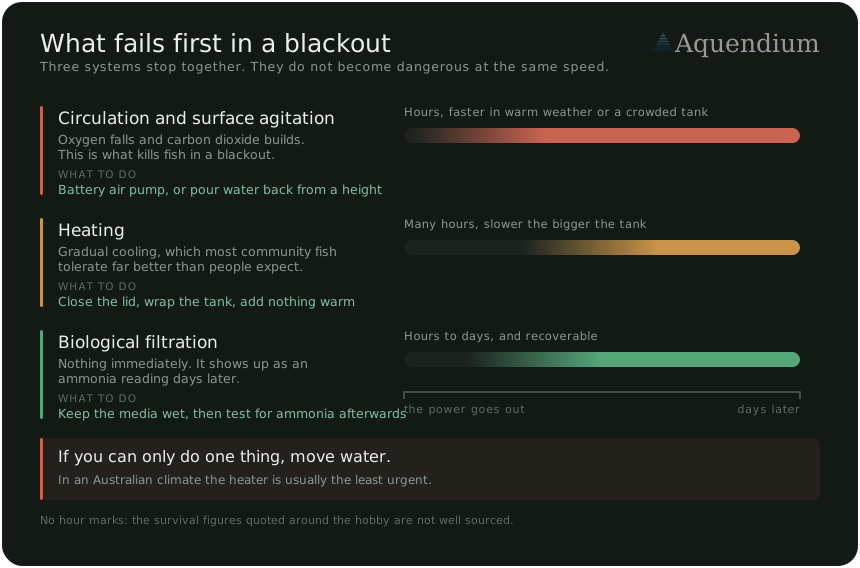
Three systems stop when the power does: circulation, heating, and filtration. They do not fail at the same speed, and knowing the order tells you where to put your effort in the first ten minutes.
Oxygen: the thing that kills first
Oxygen enters a tank at the surface, where water meets air. A filter outlet, an air stone, or a spray bar keeps that surface broken and constantly renewed. Switch all of it off and the exchange nearly stops, while the fish, the plants at night, and the bacteria in your filter all keep consuming oxygen at the same rate.
Three factors decide how fast this becomes dangerous. Temperature is the big one, because warm water holds less dissolved oxygen to begin with, which is why a summer blackout is far more serious than a winter one. Stocking level is the second: a lightly stocked planted tank has hours of slack, a crowded tank of large fish has very little. Surface area is the third, so a wide, shallow tank copes better than a tall narrow one of the same volume.
What to do, in order of preference:
- Run a battery air pump. This is the whole solution. Switch it on early rather than waiting to see how long the outage lasts.
- Agitate by hand. With no pump, scoop a jug of tank water and pour it back from a height. Thirty seconds of this every twenty minutes or so genuinely helps, and it costs nothing.
- Open the lid if the room is warm, to let the surface breathe and heat escape. Keep it closed if the room is cold, and if you have jumpers, cover the tank with mesh or a towel instead.
- Stop feeding. Fish are fine for days without food. Uneaten food rots, which consumes oxygen and releases ammonia into a tank with no working filter. There is no version of this where feeding helps.
Watch the fish rather than the clock. Crowding at the surface, gasping, and rapid gill movement all mean oxygen is running low and you need to agitate harder, right now.
Holding temperature
A tank is a large block of water, and large blocks of water change temperature slowly. The bigger the volume relative to its exposed surface, the slower it goes, which is why a 20 litre nano cools far faster than a 200 litre display tank in the same room.
Most tropical community fish are more tolerant of this than keepers fear. Our standard community range is 24 to 26°C, but a slow drift down into the low twenties over a night is an inconvenience, not an emergency. What causes real harm is a fast swing, which is also why you should never pour hot water into the tank to correct one.
To slow the loss:
- Close the lid and leave it closed.
- Wrap the tank in blankets, towels, or sheets of polystyrene, leaving the top covered too. Insulation is far more effective than any heat you can add.
- Close the curtains and shut the door to the room.
- Resist the urge to add warm water. If you genuinely must, add small amounts of dechlorinated water a little above tank temperature, slowly, and stop well before you think you need to.
In summer the problem reverses, and a blackout during a heatwave is a genuinely dangerous combination, because extreme heat is exactly when the grid is most likely to fail. That case is covered in detail in our guide to cooling an aquarium in an Australian summer.
Your filter bacteria
The nitrifying bacteria that process ammonia and nitrite live mostly in your filter media, and they need oxygen. When flow stops, the oxygen in the water sitting in the filter is consumed and the colony begins to decline.
Two things are worth being honest about here. The first is that die-off is gradual rather than sudden: the colony does not switch off at some threshold hour. The second is that the specific survival times quoted around the hobby vary enormously and are not well sourced, so treat any confident "bacteria die after X hours" claim with suspicion, including a confident one.
What is well established is the thing you can act on: wet media survives, dry media does not.
- Canister filters stay sealed and full, so the media stays wet. That is good for the bacteria, but it also means the water inside goes stale, which matters at restart.
- Hang-on-back filters can partly drain back into the tank, leaving media sitting in air. If an outage looks like lasting, lift the media out and drop it straight into the tank so it stays submerged. The same applies if you have been modifying a hang-on-back filter with extra media baskets.
- Sponge filters handle outages best of anything, because they sit in the tank and only need an air supply, which a battery pump provides directly.
So plan for a partial setback after a long outage rather than a precise one, and let your test kit tell you how big it actually was. In most cases this is a manageable bump, not a recycle from scratch.
The blackout kit
All of this is far easier if the gear is already in the cupboard. None of it is expensive.
- A battery-operated air pump, plus an air stone, some airline, and spare batteries. Check the runtime on the box, because it varies a lot between models, and buy the batteries it actually takes at the same time.
- A USB air pump and a power bank as an alternative or a backup. A phone power bank you already own will run a small USB pump for many hours.
- Blankets or polystyrene sheets for insulation, stored somewhere you can reach in the dark.
- A torch, because phone torches and open tanks are a poor combination.
- A test kit, so you can check ammonia and nitrite afterwards rather than guessing. The API Freshwater Master Test Kit is the standard choice.
- Seachem Prime, which temporarily detoxifies ammonia and nitrite as well as dechlorinating. It is the right thing to have on hand for the days after a long outage.
An uninterruptible power supply, the kind sold for computers, will run a filter and an air pump for a useful stretch and is worth considering for a heavily stocked or expensive tank. Buy one rated for Australian 240 V equipment, and size it for the filter and air pump only. Running a heater from a UPS drains it almost immediately, and per the section above, the heater is not what you are trying to save.
When the power comes back
This is where tanks are actually lost, and it takes thirty seconds to avoid.
If it smells normal, just switch it on. The longer the outage and the warmer the weather, the more likely the smell test matters, and a canister is much more prone to this than a hang-on-back or a sponge.
Then, over the following week:
- Restart the heater and let the tank come back to temperature on its own. Do not help it along.
- Test ammonia and nitrite daily for about a week. A small bump a day or two in is normal after a long outage.
- Feed lightly, or not at all for the first day, until readings are clean. A damaged filter cannot process a full feed.
- Dose Seachem Prime if ammonia or nitrite shows up, which buys time while the colony recovers. Our water conditioner calculator works out the emergency dose for your volume.
- Do a water change if readings climb rather than settle. The usual 25% applies, and our water changes guide covers the method.
If the readings behave like a tank that has lost its filter entirely, which is uncommon but possible after a multi-day outage, treat it as a partial recycle and follow the cycling guide.
Outages longer than a day
Multi-day outages happen after cyclones and severe storms, and they change the calculation. The priorities stay the same, oxygen first, but the logistics get harder.
- Batteries are the constraint. Work out how long your air pump runs on a set and ration accordingly: intermittent aeration, say twenty minutes in every hour, stretches a set a long way and is far better than nothing.
- A car is a power source. A 12 V inverter will run a small air pump or filter from a car battery. Run the engine periodically rather than flattening the battery, and never run the engine in a closed garage.
- Insulate properly if it is cold. At this timescale the temperature genuinely does start to matter, and blankets are doing more work than anything else available to you.
- Still do not feed, or feed a tiny amount every few days at most. Healthy adult fish handle a week without food without difficulty.
Finally, if outages are routine where you live, let that shape the tank itself. A larger volume rides out both temperature and oxygen swings better than a nano, a sponge filter driven by air is the most blackout-resistant filtration there is, and a lightly stocked tank has far more margin than a full one. Our filters guide covers the trade-offs, and the stocking calculator will tell you honestly how much margin you currently have.
Related reading: how to cool an aquarium in an Australian summer, choosing an aquarium filter, and how to cycle a new aquarium, or browse the species directory.