Brisbane tap water for aquariums
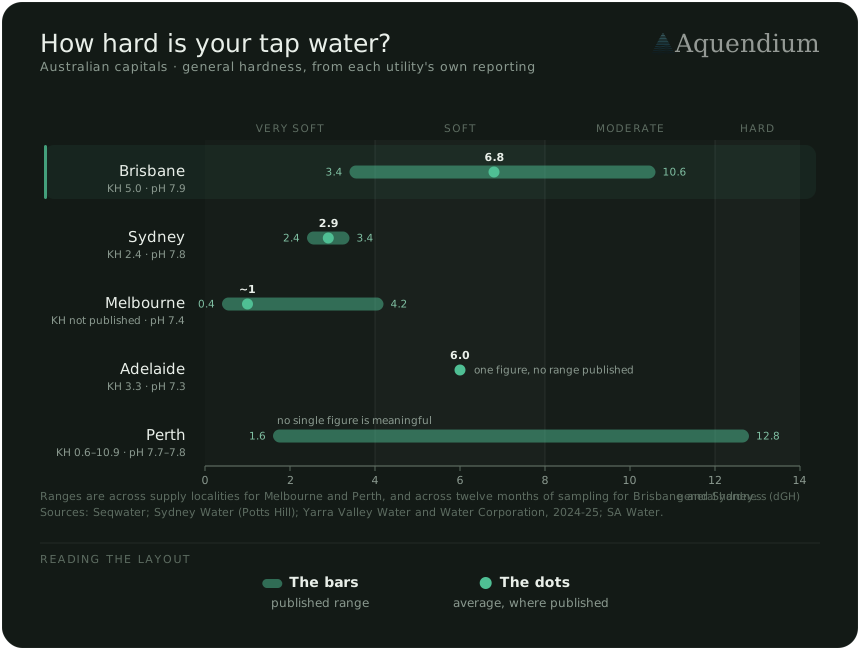
Brisbane tap water is genuinely good aquarium water, and it is almost universally described wrongly. You will read that Brisbane is a "hard water" city, so you should keep African cichlids and avoid tetras. The published numbers say something different: on the scale fishkeepers actually use, Brisbane water is soft to moderate, it is reliably alkaline, and it is unusually well buffered, which makes it one of the more forgiving supplies in the country. Here is what is really in it, taken from Seqwater's own testing, and what it means for your tank.
Published 29 July 2026 · Last updated 29 July 2026 · 9 min read
The numbers, in fishkeeping units
Water utilities report in milligrams per litre, and aquarium test kits read in degrees (dGH and dKH). That mismatch is why most local advice is vague. Below are Seqwater's published twelve-month figures for the Brisbane supply, converted at the standard 1 dGH = 17.86 ppm, which our hardness converter does both ways.
| Parameter | As reported | In aquarium units | What it means |
|---|---|---|---|
| General hardness (GH) | 121 ppm average (60 to 190) | 6.8 dGH | Soft to moderate |
| Carbonate hardness (KH) | 90 ppm alkalinity (77 to 110) | 5.0 dKH | Solid buffering, stable pH |
| pH | 7.9 average (7.5 to 8.3) | 7.9 | Reliably alkaline |
| Chloramine | 3.0 ppm average (1.2 to 3.8) | Must be neutralised | High. Dechlorinator every time |
| Nitrate | 0.07 ppm average | Effectively zero | Any nitrate you measure is your tank |
| Tap temperature | 24.2°C average (16.3 to 30.9) | 24.2°C | Close to tropical tank temperature |
One useful cross-check on those figures: Seqwater also publishes calcium (25.4 ppm) and magnesium (14.0 ppm), and calculating hardness from those two gives 121 ppm, matching the hardness they report directly. The numbers are internally consistent, which is more than can be said for most water information you will find online.
Why Brisbane is not a hard water city
This is the single most repeated error about Brisbane water, and it is worth understanding rather than just correcting, because it will help you read every other water claim you encounter.
Water utilities and filter companies use a plumbing scale, where hardness above roughly 60 ppm counts as "moderately hard" and 120 ppm is "hard". They are measuring the risk of scale in your kettle. Fishkeepers use the aquarium GH scale, where soft runs to 140 ppm, moderate to 210 ppm, and hard does not begin until 211 ppm. Same water, entirely different verdict.
At 121 ppm, Brisbane sits near the top of soft on our scale and near the bottom of hard on theirs. So a plumber will tell you Brisbane has hard water, and be right by their measure, while an aquarist repeating it will send you to buy the wrong fish.
Chloramine, and why standing water will not do
This is the part that genuinely catches Brisbane fishkeepers out, especially anyone who has moved from Melbourne or Adelaide.
Brisbane's supply is disinfected with monochloramine, averaging about 3 ppm, and Seqwater's testing shows almost no free chlorine. Chloramine is chlorine bonded to ammonia, and the important property is that it does not evaporate. The old advice to fill a bucket and leave it overnight works for chlorine. In Brisbane it does nothing at all: after twenty-four hours you still have a bucket of chloraminated water that will burn gills.
There is a second consequence worth knowing. When a dechlorinator breaks the chloramine bond it releases ammonia into the water. Good conditioners bind it, and an established filter handles the rest easily, but during a large water change on a young or lightly cycled tank it is one more reason not to change enormous volumes at once. Our water changes guide covers sensible volumes.
What this water is like to keep fish in
Three things follow from the numbers, and on balance Brisbane comes out well.
Your pH will be stable, and that is a real advantage. At 5.0 dKH there is enough buffering to hold pH steady against the acids a tank naturally produces. Beginners in very soft cities like Melbourne have to watch for pH crashes; in Brisbane that is rarely the failure mode. Stable water forgives a lot.
Your tap nitrate is effectively zero. At 0.07 ppm, any nitrate your test kit shows is being produced inside your tank, so a rising reading means stocking, feeding or maintenance, never the tap. That makes nitrate a clean, trustworthy signal here, which is not true everywhere in Australia.
Water changes are easy to temperature-match. Brisbane tap water averages 24.2°C, which sits inside the normal tropical range of 24 to 26°C, so matching temperature is usually a small adjustment rather than a careful mixing exercise. The exception is a hot summer, when the tap itself can reach 30°C and adds heat to a tank that is already struggling. See how to cool an aquarium in an Australian summer.
Fish that suit Brisbane water
Alkaline, moderately mineralised, stable water suits a wide range of fish. These do well straight from the tap.
- Livebearers. Guppies, platies, and Endler's livebearers all enjoy the alkaline pH. Their ideal GH sits a touch above Brisbane's, so they thrive as-is but colour up best with a little added mineral hardness, which a bag of crushed coral in the filter provides.
- Rainbowfish. Built for exactly this water, widely stocked locally, and superb in a mature tank. See our native Australian fish guide, since several natives share the same requirements.
- Snails. Nerites and mystery snails need minerals for shell growth and get enough here.
- Neocaridina shrimp. Cherry shrimp want exactly this profile, and Brisbane is close to ideal for them (see keeping freshwater shrimp).
- Most community fish. Corydoras, danios, barbs, gouramis and peaceful tetras cope perfectly well with 6.8 dGH at pH 7.9, even where their wild habitat is softer.
Two groups need more thought. Soft-water specialists such as chili rasboras, discus, and the German blue ram would rather have softer, more acidic water, and while the GH here is not the obstacle, the alkaline pH is. And African rift lake cichlids, which are traditionally recommended for Brisbane, actually want 10 dGH and above, well beyond what comes out of the tap. They need remineralising here, with crushed coral, an aragonite substrate or a rift salt, exactly as they would anywhere in Australia.
When to adjust it, and when not to
For most tanks, the answer is do not. Brisbane water is stable, predictable and suits a broad range of fish, and chasing a target number introduces more risk than it removes. Every adjustment has to be repeated identically at every water change, forever, and an inconsistent adjustment is worse than none.
The cases where it is genuinely worth it:
- Raising GH and KH for rift cichlids. Crushed coral or aragonite in the substrate or filter, or a commercial rift lake salt. Straightforward, because raising minerals is far easier than lowering them.
- Softening for Caridina shrimp or a soft-water biotope. This means RO water plus a remineraliser, which is real ongoing work and cost. Worth it for crystal shrimp, rarely worth it for a community tank.
- A planted tank running CO2. The strong KH is an asset, since it stops the pH swinging as CO2 comes on and off. Our CO2 guide covers the interaction.
What is not worth doing is chasing pH with bottled "pH down" products. Against 5.0 dKH of buffering they are fighting chemistry, and the result is a sawtooth of drops and rebounds that stresses fish far more than a steady 7.9 ever would.
Suburbs, seasons and tank water
The figures above are network averages, and the twelve-month range runs from 60 to 190 ppm hardness, so your suburb may sit meaningfully above or below 121. South East Queensland draws on a connected grid of sources, including the Mount Crosby plants on the Brisbane River and North Pine, and which one is feeding your area, along with recent rainfall, moves the numbers. Rain events in particular can soften the supply for a while.
None of that changes which fish suit Brisbane, since the whole range stays soft to moderate and alkaline. But if you are doing something precise, breeding, running CO2, or keeping shrimp, test your own tap rather than trusting a city-wide average. A GH and KH kit costs little and settles it in five minutes.
Related reading: aquarium water parameters explained, best freshwater fish for Australian tap water, and aquarium water changes, or browse the species directory.