How to get the most from a sponge filter
A sponge filter is the cheapest piece of filtration you can buy and the one most often dismissed as a beginner's compromise. It is not. In a shrimp tank, a fry tank, a quarantine tank, or any tank that has to survive a blackout, it outperforms filters costing twenty times as much, and it does so with almost nothing to go wrong. It also rewards a handful of cheap changes, in the same way a hang-on-back filter does. This guide covers how it actually works, where it wins and where it genuinely does not, and the upgrades worth making.
Published 16 October 2026 · Last updated 16 October 2026 · 10 min read
How a sponge filter actually works
Almost everyone's mental model of a sponge filter is wrong in a way that matters, so it is worth getting right before buying one.
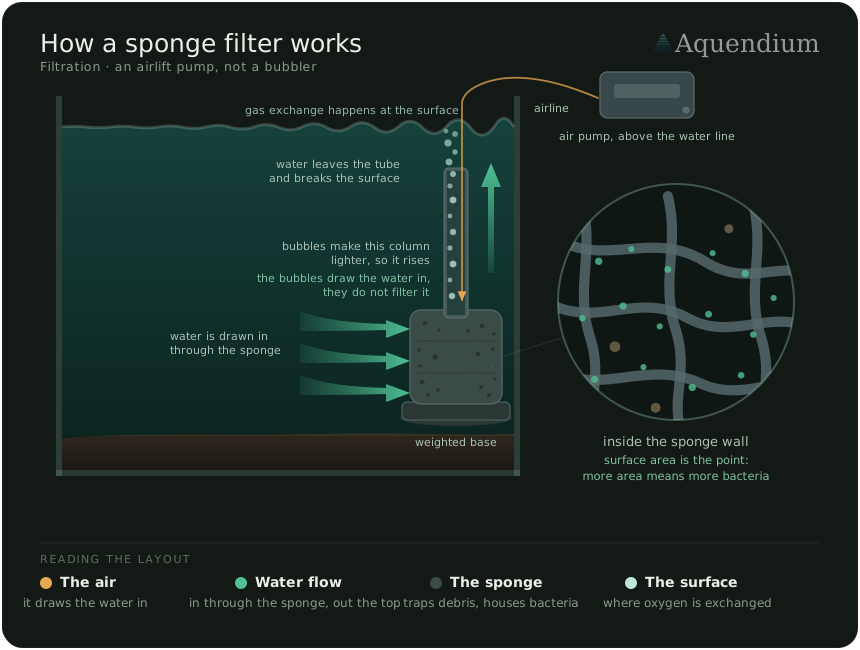
A sponge filter is an airlift pump. An air pump outside the tank pushes air down a line to the base of a vertical lift tube. Those bubbles rising inside the tube make the column of water in it lighter than the water around it, so that column rises and spills out of the top. Water has to replace it from below, and the only route in is through the sponge. That is the whole mechanism: the bubbles move water, and the moving water is drawn through the sponge.
Two things follow, and both correct common assumptions.
The bubbles are not filtering anything. They are the engine, not the filter. A sponge filter with a vigorous bubble stream and a collapsed or clogged sponge is doing very little.
The bubbles are not doing much of the oxygenating either. Gas exchange happens overwhelmingly at the water's surface, and a bubble's brief trip up a lift tube contributes little directly. What oxygenates the tank is the water the filter returns to the surface, breaking and renewing it constantly. This is why aiming the outflow matters, and it is the same reason surface agitation is the thing to protect in a power outage.
The sponge itself does both jobs a filter needs to do. It traps debris mechanically, and far more importantly its enormous internal surface area houses the bacteria that process ammonia and nitrite. Our filters guide covers how that fits alongside the other filter types, and the cycling guide covers what those bacteria actually do.
Where they win, and where they do not
A sponge filter is not a lesser version of a hang-on-back. It is a different tool, and there are tanks where it is simply the right answer.
| Situation | Why a sponge filter suits it |
|---|---|
| Shrimp tanks | No impeller and no narrow intake, so shrimplets cannot be drawn in or minced. See our shrimp guide. |
| Fry and grow-out tanks | Same reason, and the gentle flow does not exhaust small fish. Relevant if you are breeding deliberately. |
| Quarantine and hospital tanks | Cheap enough to dedicate to the job, easy to sterilise, and with no cartridges or carbon to strip out the medication you just added. See quarantining new fish. |
| Nano tanks | A small sponge displaces little water and will not create a current that pins a betta against the glass. |
| Blackout resilience | It needs only air, so a battery air pump keeps it filtering and oxygenating at once. Nothing else in the hobby is this easy to keep running. |
| Seeding a new tank | Run a spare sponge in an established tank for a few weeks, then move it to the new one with a mature colony already in it. |
The honest limits are worth stating just as plainly, because a sponge filter is the wrong choice in some tanks.
- It does not skim the surface. A sponge filter draws from mid-water, so the oily protein film that collects on the surface stays there. A hang-on-back pulls from the top and deals with it, and adding a surface skimmer to one is a standard modification.
- There is nowhere to put chemical media. If you want to run Seachem Purigen or carbon, a sponge filter has no basket for it. That is usually fine, but it is a real constraint.
- It is visible. It sits in the tank, in view, and no amount of planting entirely hides a black cylinder.
- The air pump makes noise. Not the filter, the pump. This is the most common reason people abandon them, and it is addressed below.
- It struggles with a heavy bioload. A tank of large, messy fish produces more waste than one sponge can process, and it generates coarse debris a sponge clogs on. Run several, or run a canister.
Setting one up properly
There is very little to it, but three of these steps are skipped routinely and two of them can cost you a pump.
- Soak and squeeze the sponge in tank water first. A dry sponge is full of air and will float stubbornly. Squeezing it underwater a few times sinks it immediately.
- Fit a check valve in the airline. If the pump ever sits below the water line, or the power cuts, water can siphon back down the airline and into the pump, which ruins it and can empty part of your tank onto the floor. A check valve is a one-dollar part that prevents both. Fit it the right way round, and fit it even if the pump currently sits above the tank.
- Mount the pump above the water line where you can. Belt and braces with the check valve, not instead of it.
- Set the depth so the outflow breaks the surface. You want the returning water disturbing the surface, not discharging deep and quietly. That is where your gas exchange comes from.
- Add a control valve if you run more than one. A gang valve lets you balance air between two sponges rather than having the nearest one take most of it.
- Seed it. A new sponge is sterile. Squeeze an established sponge or filter media over it, or run it in a mature tank for a few weeks first. Otherwise treat the tank as uncycled and follow the cycling guide.
The upgrades worth doing
None of these need tools or skill, and each addresses a specific weakness.
Buy a bigger sponge than the tank needs
Sponge filters are usually sold with a tank-size rating, and those ratings are conservative about nothing except your convenience. A sponge rated for a larger tank holds more bacteria, traps more debris before flow drops, and therefore needs cleaning less often. There is no downside beyond the physical space it occupies, and the price difference between sizes is trivial.
If you are choosing between one large sponge and the next size down, take the large one.
Run two instead of one
Two smaller sponges in opposite corners beat one larger sponge in the middle, for three reasons. Flow reaches both ends of the tank. If one clogs or an airline comes adrift, the tank is not unfiltered. And, most usefully, you can clean them on alternating fortnights, so you never disturb more than half your bacterial colony at once.
That last point is the real prize, and it is the same logic as running two heaters rather than one in a large tank.
Choose coarse pores over fine
Fine-pore sponge polishes water more effectively, which is appealing until you realise it also blocks faster, and that a blocked sponge moves less water and therefore does less biological work. Coarse pore keeps flowing for longer between cleans and still holds plenty of bacteria.
If you want genuinely polished water, that is a job for fine mechanical media in a different filter, not for the sponge that is also carrying your biological filtration.
Deal with the pump noise at the source
Most of the noise people blame on a sponge filter is the air pump vibrating against whatever it is sitting on, which amplifies it like a soundboard. Three things help, in order of effect: stand the pump on something soft and dense, such as a folded towel or a piece of foam; hang it from a hook so it touches nothing rigid; and keep it off the same surface as the tank itself, because a cabinet top transmits vibration beautifully.
The second source is the bubbles bursting at the surface. Raising the sponge slightly so the lift tube discharges just under the surface, rather than firing bubbles into the air, quietens that considerably.
Add one alongside the filter you already have
You do not have to choose. A sponge filter running quietly in a corner alongside a hang-on-back or canister gives you three things for a very small outlay: extra biological capacity, a backup that keeps working if the main filter fails, and a permanently seeded sponge ready to start a quarantine or hospital tank at no notice.
That last use is worth the price on its own. A mature spare sponge means a quarantine tank is cycled the moment you need it, which is usually the moment you have just bought fish.
Maintenance without killing the cycle
The sponge is not a consumable. It is where your bacteria live, so the goal of cleaning is to restore flow while disturbing the colony as little as possible.
- Clean when the flow drops, not on a schedule. A sponge that is still moving water well is working.
- Squeeze it out in a bucket of tank water. Take the water from the tank during a water change, squeeze the sponge in it until the worst comes out, and put the sponge back. Do not aim for clean, aim for flowing.
- Never rinse it under the tap. Chlorine and chloramine will kill a large part of the colony, and Australian supplies carry one or the other everywhere. Our water changes guide covers the routine this fits into.
- Do not replace it on principle. Replace a sponge only when it is physically disintegrating, and when you do, run the old and new side by side for several weeks so the new one is seeded before the old one leaves.
- Stagger it if you run two, so you never clean both in the same week.
- Check the airline and valve occasionally. Airline hardens and cracks with age, and a check valve can stick. Both are cheap to replace and annoying to discover during an outage.
Australian notes
Buy Australian-certified 240 V equipment. Air pumps are cheap, which makes uncertified overseas imports tempting, and an uncertified mains appliance running continuously next to a tank of water is not a risk worth taking for a few dollars. Our filters guide covers brand availability here.
Summer makes the surface matter more. Warm water holds less dissolved oxygen, so the agitation a sponge filter provides counts for more in February than in July. If your tank runs hot, a sponge filter is a genuinely useful addition rather than just a filter, and our guide to cooling an aquarium in an Australian summer covers the rest.
It is the filter that survives a blackout. Storm season takes the power out, and a sponge filter is the only common filtration that a cheap battery air pump can keep running exactly as designed, filtering and oxygenating at the same time. If outages are routine where you live, that alone is a reason to have at least one sponge filter in the house, and our power outage guide explains why oxygen is the thing that runs out first.
Related reading: choosing an aquarium filter, how to modify a hang-on-back filter, and what to do when the power goes out, or browse the species directory.