Aquarium pests and hitchhikers: what to worry about
Sooner or later you will turn the light on and find something moving that you did not put there. Tiny white worms in the substrate, specks darting across the glass, or a small pale thing waving tentacles from the front pane. The instinct is to assume the worst and reach for a treatment. Resist it, because most aquarium hitchhikers are harmless, several are actively good signs, and the handful that genuinely matter are easy to recognise once you know what separates them. This guide sorts them into leave alone, keep an eye on, and act now.
Published 29 July 2026 · Last updated 19 August 2026 · 13 min read
How hitchhikers get in
Nothing appears from nowhere. Almost everything arrives by one of five routes, and knowing which explains why the problem showed up when it did.
- Live plants. By far the most common. Snail eggs, hydra, planaria, flatworm cocoons and insect larvae all travel on plant leaves, and a rinse does not remove them. This is exactly what our plant dipping guide exists to prevent.
- The water fish come home in. Bag water from a shop tank carries whatever that tank had, which is one of several reasons to net fish across rather than tip the bag in.
- Live and frozen foods. Live blackworms, daphnia and similar can carry hitchhikers, particularly if collected rather than cultured.
- Secondhand gear and shared equipment. A used filter, net or siphon that has not been dried or disinfected moves organisms between tanks efficiently.
- Anything collected from outdoors. Wild-collected wood, rocks, plants or pond water bring in insect larvae and leeches. This is the route that produces the genuinely dangerous arrivals.
Identifying what you have found
Find the photo that matches what you are seeing. Click the picture to enlarge it, or the name underneath to open the full card, where the chip tells you how concerned to be.
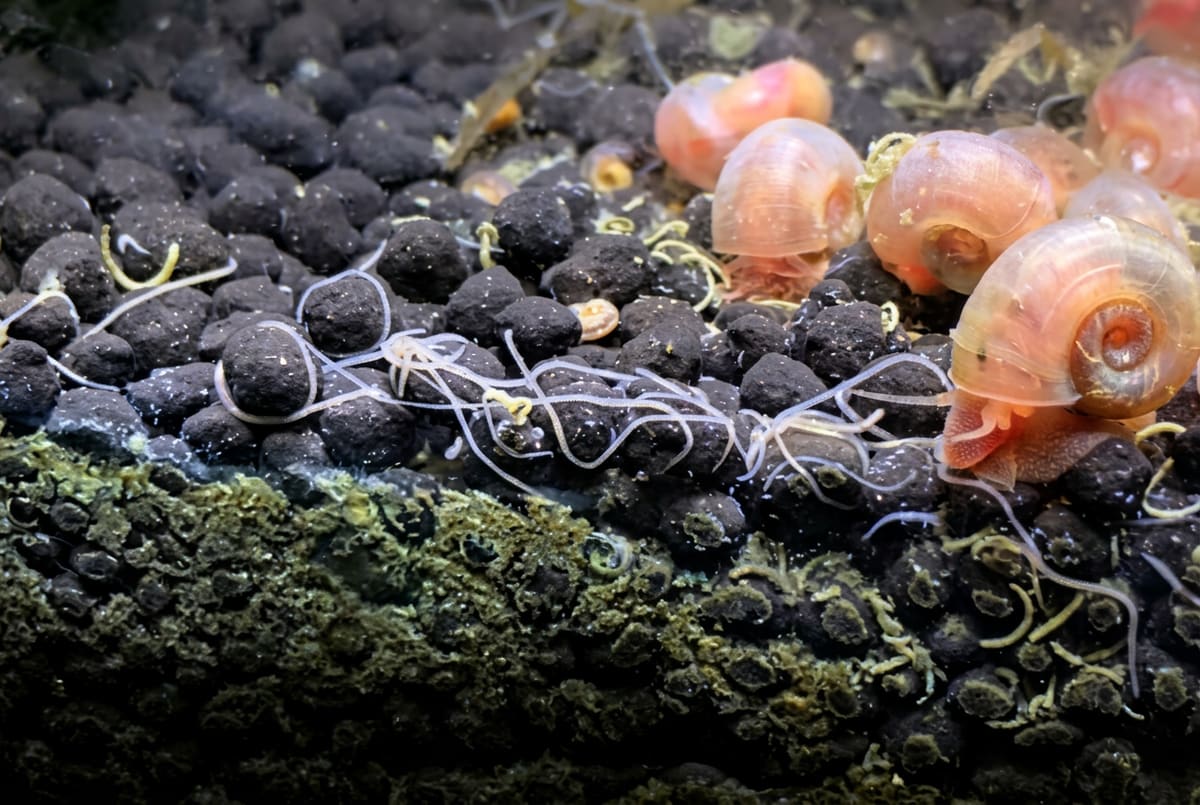
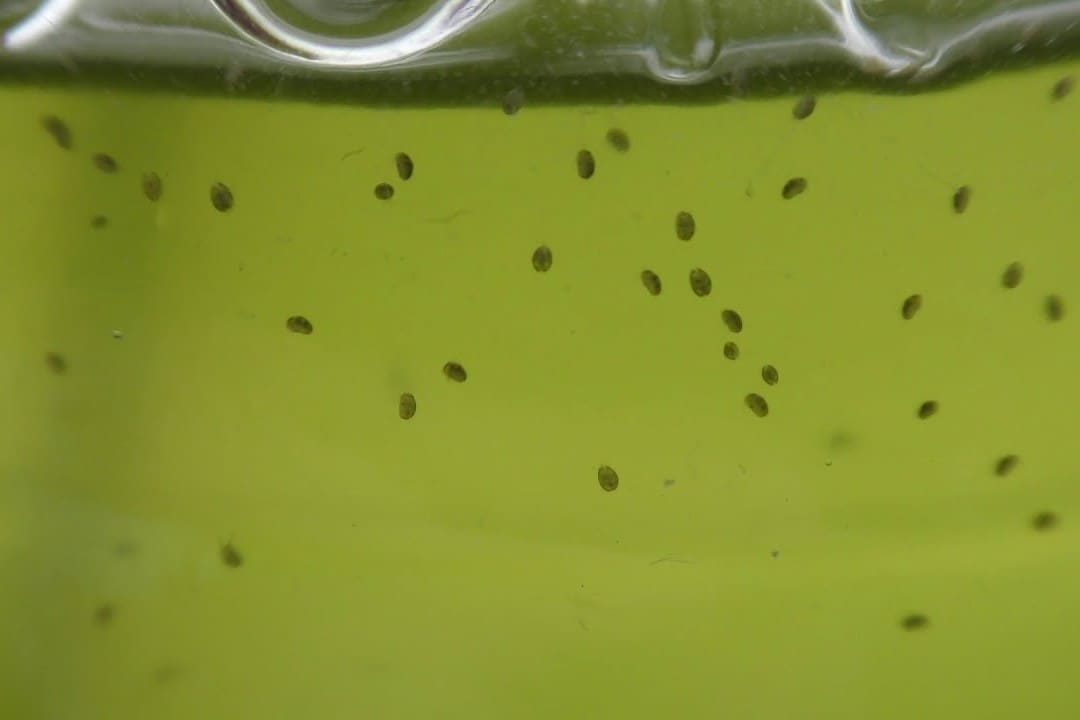
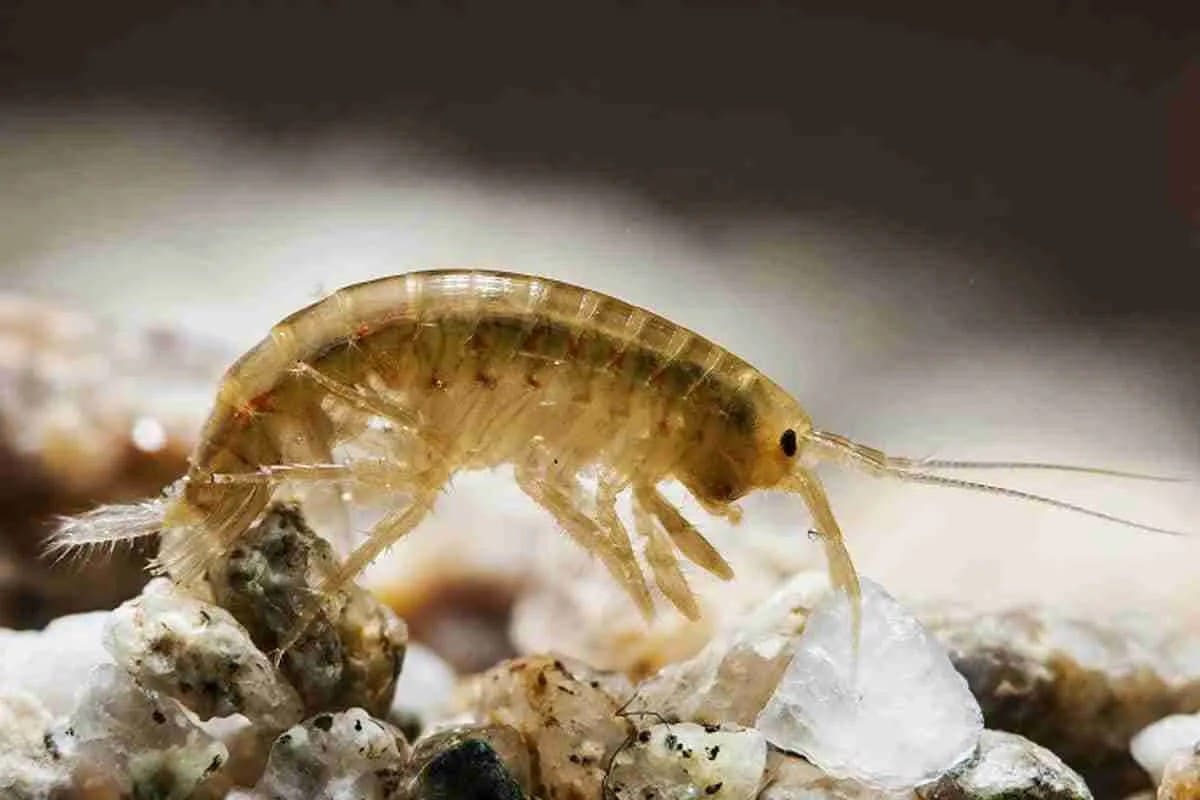
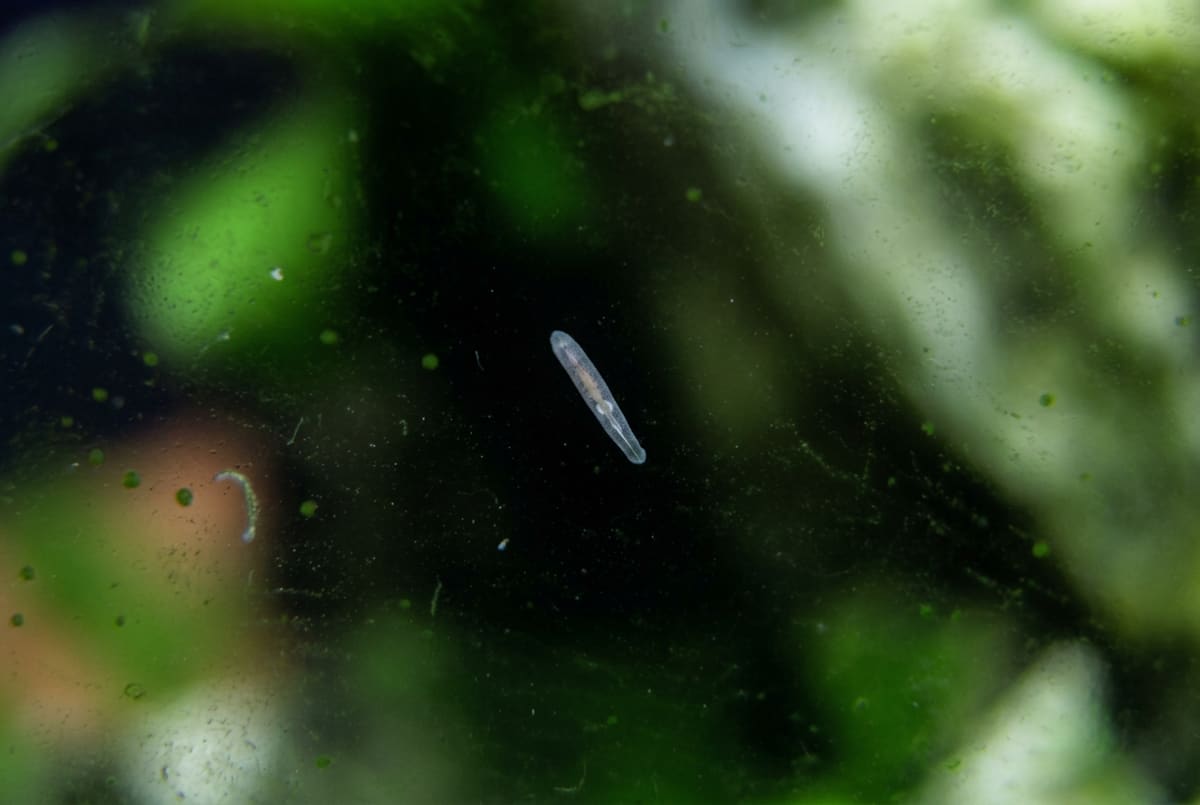
Nothing matching? If what you have found is on the fish rather than living in the tank, it is a parasite rather than a hitchhiker, and it is covered in the last card below and in our common fish diseases guide.
Detritus worms
What you see: very thin white, tan or pinkish threads, a few millimetres to a couple of centimetres long, wriggling in a whip-like motion. Usually in the substrate, often noticed in a cloud after you disturb the gravel, or occasionally swimming in the water column.
What they are: harmless segmented worms that live in the substrate eating waste and leftover food. Almost every established tank has them, most keepers just never see them.
What to do: nothing, medically speaking. Large numbers in open water mean the substrate is holding a lot of organic waste, so treat them as a maintenance prompt rather than a pest: feed a little less, and vacuum the substrate more thoroughly at water changes. They will retreat back out of sight. Many fish will happily eat them.
Do not confuse with: Camallanus worms, which protrude as short red threads from a fish's vent and are a genuine parasite. See our common fish diseases guide. Detritus worms are in the substrate, never attached to a fish.
Copepods and seed shrimp
What you see: tiny white or grey specks, around a millimetre, on the glass and among plants. Copepods dart in sharp jerky hops. Seed shrimp (ostracods) look like miniature grains of rice or sesame seeds and scuttle steadily rather than hopping.
What they are: microscopic crustaceans grazing on biofilm and detritus. Their presence is a sign of a mature, biologically active tank, and they are free live food. Fry in particular hunt them enthusiastically.
What to do: nothing. If the numbers become visually distracting, the cause is surplus food, so feed less and they will thin out. They cannot harm fish, shrimp or plants.
Scuds and amphipods
What you see: small shrimp-like creatures up to about a centimetre, flattened side to side rather than top to bottom, scurrying through the substrate and along surfaces, often on their sides.
What they are: freshwater amphipods, usually arriving on plants. They are scavengers that eat detritus, leftover food and decaying plant matter, and they are excellent live food for anything big enough to catch them.
What to do: generally nothing. In very large numbers they may graze on soft or already-damaged plants, and they compete with shrimp for food, so shrimp keepers sometimes thin them out. Reducing feeding is the control. They do not attack healthy fish or adult shrimp.
Rhabdocoela, the harmless flatworm
What you see: small white or translucent worms, usually under 5 mm, gliding smoothly across the glass and plant leaves. Crucially, the head end is rounded or blunt.
What they are: a harmless flatworm that grazes biofilm. They are extremely common in shrimp tanks and planted tanks, and they are the single most misidentified organism in the hobby.
What to do: nothing at all. They do not eat shrimp, eggs, fish or plants. Before you treat anything for planaria, read the next section, because the treatment is far more dangerous to your tank than these worms are.
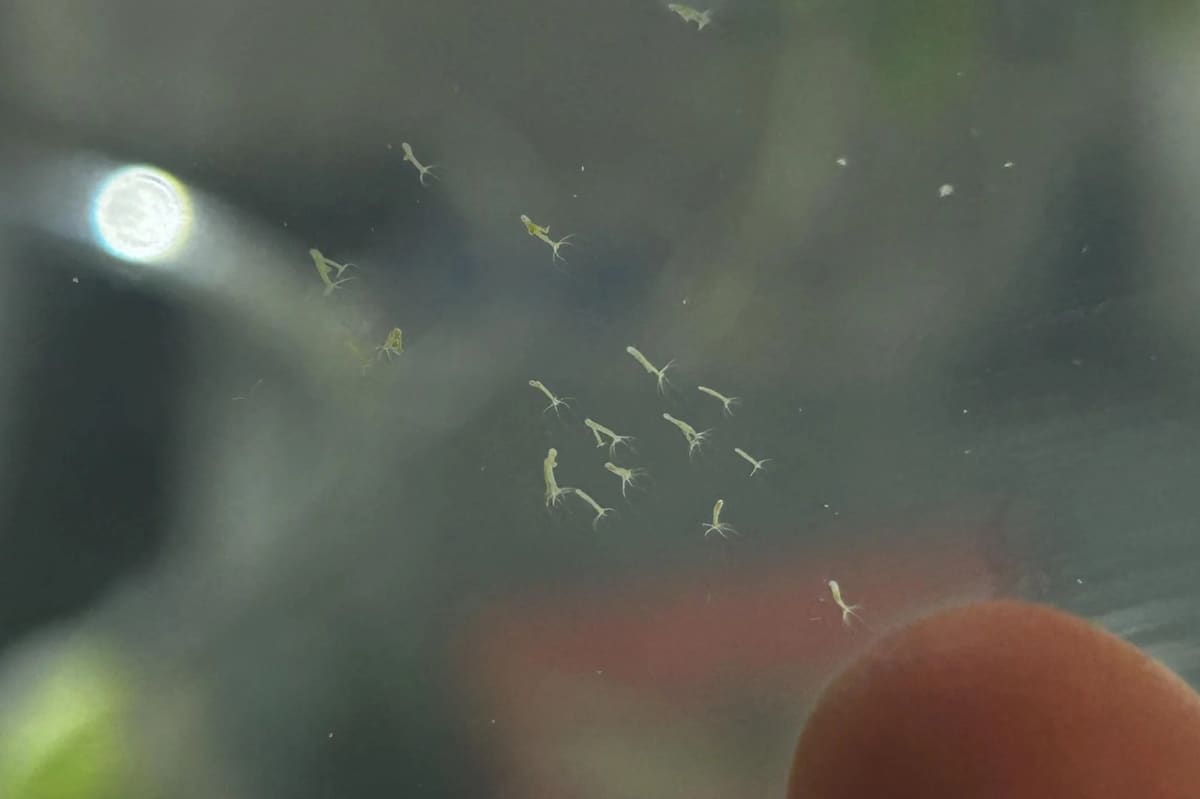
Hydra
What you see: a small pale stalk, typically 2 to 10 mm, anchored to the glass, a leaf or the hardscape, with several fine tentacles waving from the free end. They stay put and contract into a blob when disturbed.
What they are: tiny relatives of jellyfish and anemones. They are stinging predators, but they can only catch things smaller than themselves.
Do they matter? It depends entirely on your tank. In a normal community tank of adult fish, hydra are a curiosity and harm nothing. In a shrimp tank or a breeding tank they are a genuine problem, because they catch and eat newly hatched shrimplets and small fry (see keeping freshwater shrimp).
What to do: hydra bloom on surplus food, so cutting feeding right back removes what feeds them and populations often collapse by themselves. Scrape any you can see off the glass and siphon them out during water changes. Some fish, particularly gouramis and bettas, will pick at them. Chemical treatments exist but carry real risk to snails, so read the treatment section below before reaching for one.
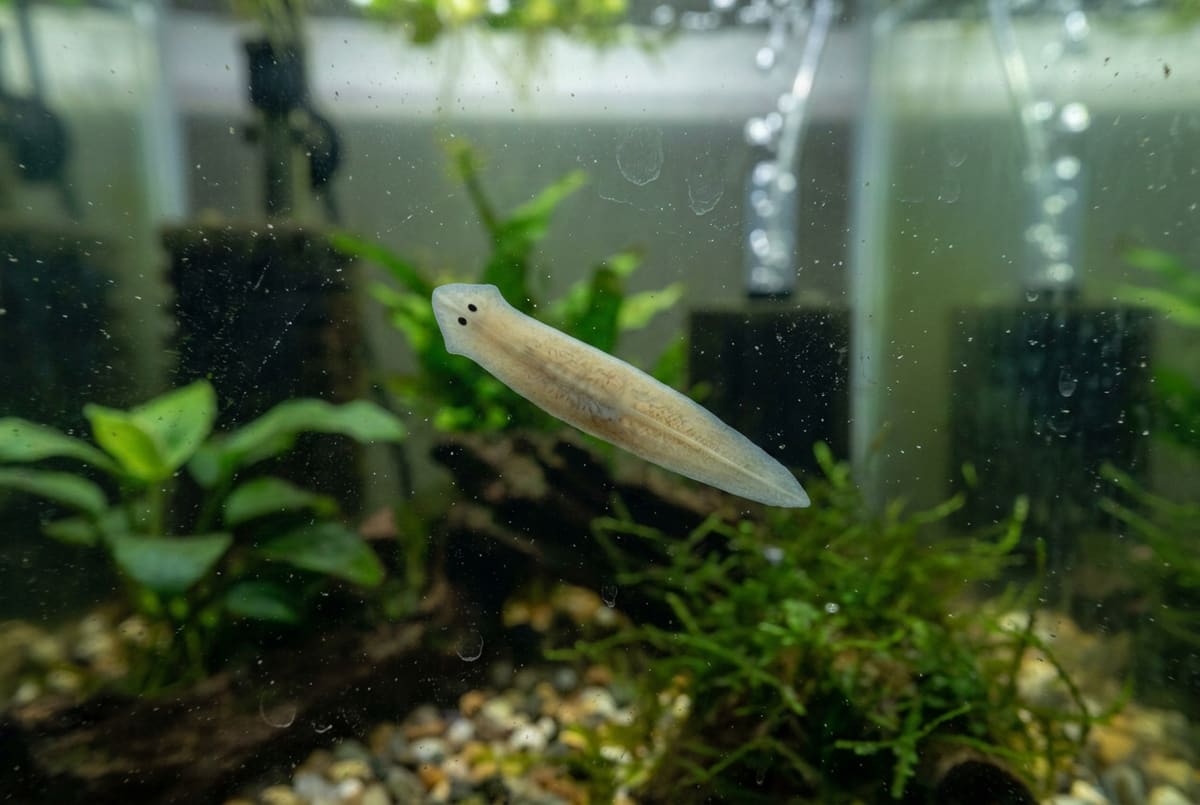
Planaria
What you see: a flatworm gliding smoothly over glass and substrate, commonly 5 to 20 mm, and the identifying feature is the head: a distinct triangular or arrow-shaped head with two visible eyespots that give it a cross-eyed look.
What they are: predatory and scavenging flatworms. They hunt slowly, and they will take fish eggs, weakened or moulting shrimp, shrimplets and small snails. They do not attack healthy adult fish.
Do they matter? In a fish-only community tank, honestly not much: they signal excess food and little else. In a shrimp tank they are a serious pest, because a moulting shrimp is defenceless and shrimplets are easy prey.
What to do: cut feeding hard, since planaria populations are driven by surplus food. Trap them, which works well: a small bottle or purpose-made trap baited with a piece of raw prawn or bloodworm, left in overnight and removed in the morning, takes out large numbers with no chemicals. Repeat over several nights. Only if trapping fails should you consider a chemical treatment, and the section below explains why that needs care.
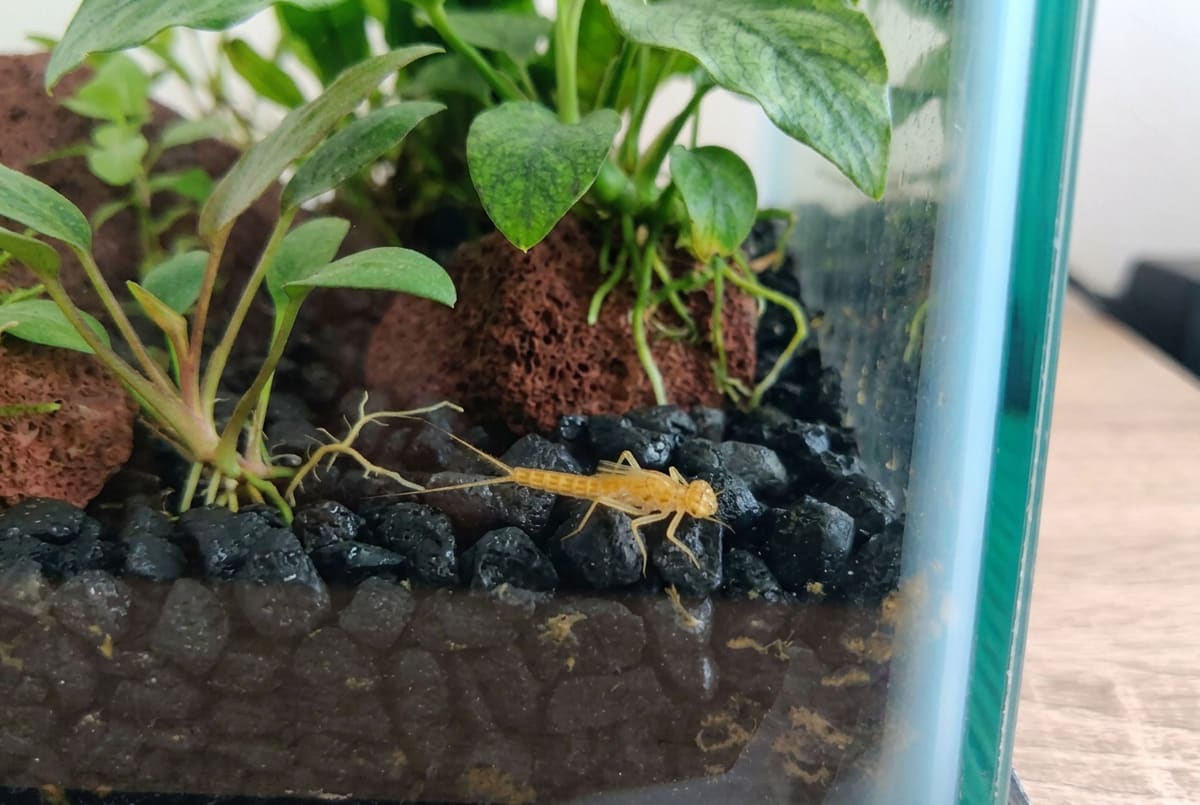
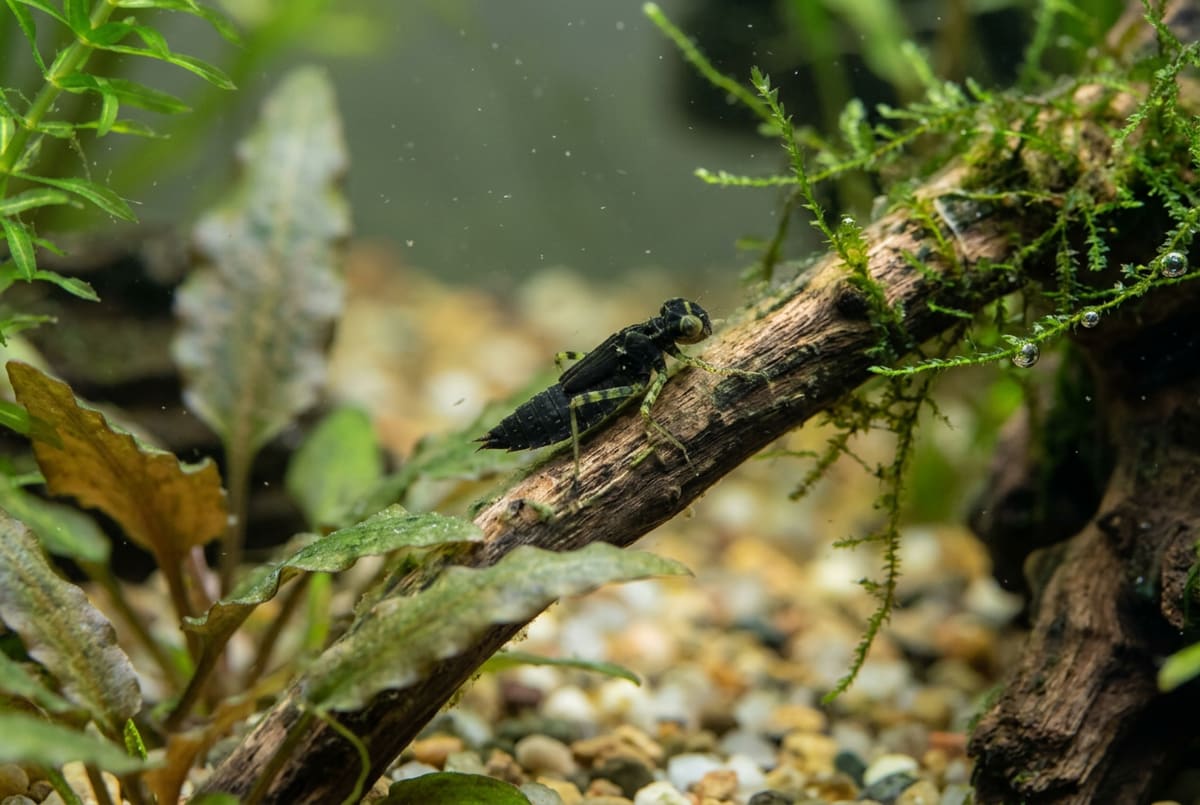
Dragonfly and damselfly nymphs
What you see: a squat, six-legged, drab brown or green insect larva, roughly 1 to 4 cm, usually sitting very still among plants or on the substrate. Damselfly nymphs are slimmer with three feathery tails; dragonfly nymphs are bulkier and blunt-ended. Both are pictured on the cards above, and the tails are the quickest way to tell them apart.
What they are: the aquatic juvenile stage of dragonflies and damselflies, and they are ambush predators with an extendable hinged jaw they fire out to seize prey. They will kill shrimp and small fish, including fish considerably larger than you would expect.
How they arrive: almost always on plants collected from a pond or waterway, or in water from an outdoor pond. They cannot appear in a tank stocked entirely from a shop.
What to do: remove them manually, straight away. Net or trap them out the moment you see one, and check thoroughly for others, as where there is one there are usually more. There is no practical chemical control that would not also harm your shrimp. This is the most common reason for fish and shrimp mysteriously vanishing from a tank containing wild-collected plants.
Leeches
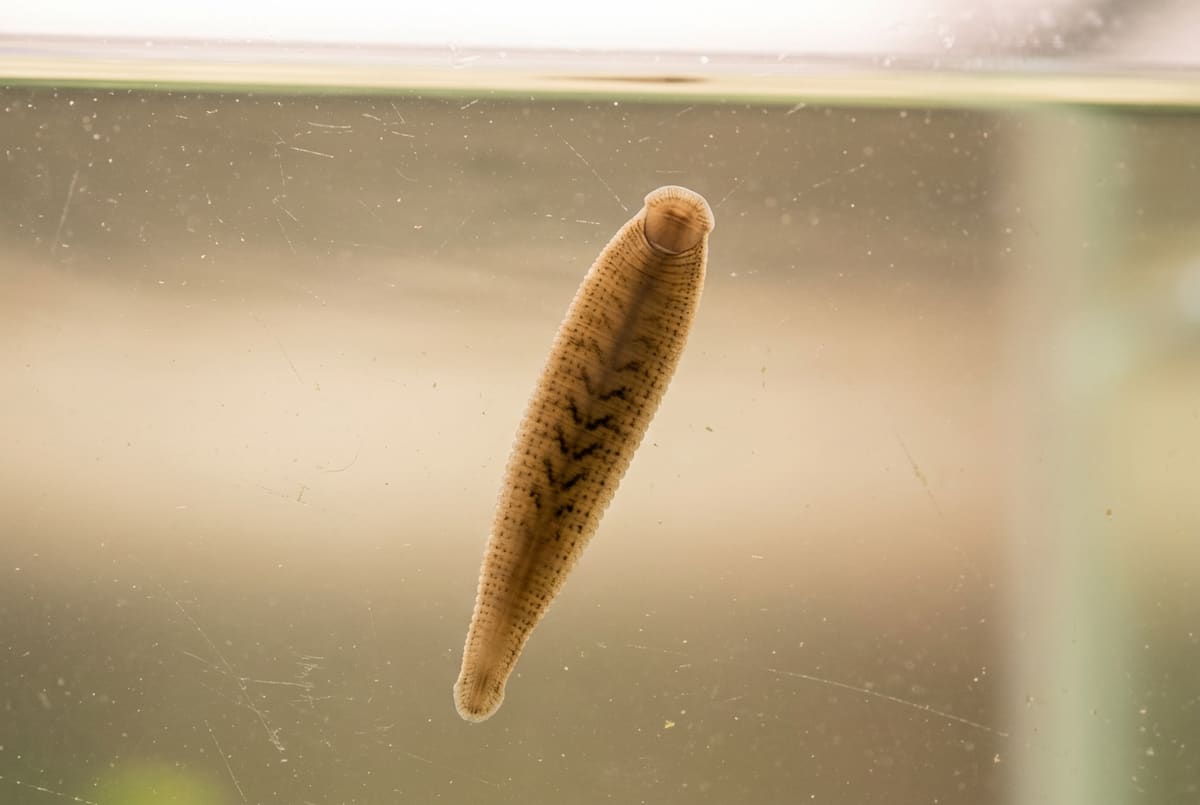
What you see: a segmented worm that moves with a distinctive looping, inch-worm motion and can stretch and contract dramatically. Usually brown, grey or black, and often found on the glass or under decor.
What they are: most leeches that turn up in aquariums are scavengers on detritus and snails rather than fish parasites, so the picture is less dire than the name suggests. Some species do feed on fish, however, and telling them apart is not realistic for a hobbyist.
What to do: remove them manually and treat the tank as needing a thorough clean and inspection. If you find one attached to a fish, do not pull it off forcefully, as that can leave mouthparts in the wound and cause a worse infection. Consult our diseases guide and treat the resulting wound. Like nymphs, leeches almost always arrive with wild-collected plants, wood or pond water.
Anything attached to a fish
Everything else on this page lives in the tank. If the organism is on the fish, the category changes from hitchhiker to parasite, and it needs treating rather than tolerating.
Fish lice are flat, disc-shaped, greenish crustaceans up to about 5 mm, visible moving across a fish's flanks. Anchor worm appears as a fine white or greenish thread protruding from a raised or reddened sore, with a forked end. Camallanus worms show as short red threads at the vent. All three are treatable, but none will resolve on its own, and all are covered in our common fish diseases guide.
Fish flicking against surfaces, clamped fins, or unexplained sores warrant a close look even if you cannot see anything attached.
The worm problem: which one is it?
Most unnecessary treatments trace back to one mix-up, so it is worth doing carefully. Three different things get called "little white worms", and only one of them is worth treating. The photos above show what each looks like; this is the same call in words, for the two things a photograph struggles with, namely how the worm moves and the shape of its head. The fourth row is the odd one out, included because it is the worm people most often fear they have.
| What you see | Almost certainly | Verdict |
|---|---|---|
| Thin threads wriggling in the substrate or water | Detritus worms | Harmless. Feed less |
| Small worms gliding on glass, rounded head | Rhabdocoela | Harmless. Do nothing |
| Worms gliding on glass, triangular head with eyespots | Planaria | Act if you keep shrimp |
| Red threads at a fish's vent | Camallanus worms | Parasite. Treat the fish |
The distinction that decides everything is motion and head shape. Wriggling in the substrate is a detritus worm. Gliding smoothly means a flatworm, and then the head shape separates the harmless one from the one worth acting on. A phone camera macro shot, or a photo through a magnifying glass, settles it in seconds and is worth taking before you dose anything.
Dealing with the ones that matter
The order matters here, because the cheapest and safest measures are also the most effective long-term.
First, cut the food supply. Hydra and planaria populations are built on surplus organic matter. Feed less, remove uneaten food, vacuum the substrate properly and step up water changes. This alone resolves many outbreaks, and without it any treatment is temporary because the conditions that produced the bloom are still there.
Second, remove them physically. Scrape hydra off the glass and siphon them out. Trap planaria overnight with a baited bottle trap. Net out nymphs and leeches on sight. This is slow but carries no risk to anything else in the tank.
Only then consider a chemical treatment, and understand what you are taking on.
For shrimp keepers, this is the honest summary: trapping and feeding less will handle most planaria and hydra problems, and it does so without ever putting your colony at risk. Chemicals are a last resort for an infestation that is actually costing you shrimp, not a first response to spotting one worm.
Keeping them out next time
Prevention is far easier than removal, and it is nearly all about what you put into the tank.
- Dip new plants. The single highest-value habit, and the one that stops snails, hydra, planaria and insect larvae in one step. Our plant dipping guide covers the methods, and tissue-cultured plants arrive sterile if you would rather skip dipping entirely.
- Never tip shop water into your tank. Net fish across and discard the bag water.
- Quarantine new fish. It catches parasites as well as disease, and stops both reaching your display tank (see quarantining new fish).
- Be cautious with anything from outdoors. Wild-collected plants, wood, rocks and pond water are the route that brings in the genuinely dangerous predators. If you use them, quarantine them in a bucket for a couple of weeks and inspect before they go in.
- Dry or disinfect shared equipment. Nets, siphons and containers move organisms between tanks readily.
- Feed less. It comes up in every section for good reason: it is the one habit that keeps every opportunistic organism in the tank at low, invisible numbers.
Australian notes
The dangerous arrivals are the local ones. Nearly everything on this page is harmless and cosmopolitan, but the two that genuinely hunt your livestock, dragonfly and damselfly nymphs and leeches, almost always come from an Australian pond, dam or creek rather than a shop. A dragonfly nymph cannot materialise in a tank stocked entirely from a retailer. If yours contains wild-collected wood, rocks, plants, or water from an outdoor pond or rainwater tank, that is where it came from, and it is worth a careful look at everything else you added at the same time.
Wild collecting is not the free option it looks like. Beyond the predators, taking plants or animals from Australian waterways runs into fisheries and biosecurity rules that differ by state, and some of what grows in local waterways is a declared weed. Our guide to aquarium plants in Australia covers the national weed list and the stricter Western Australian position. Buying from a shop, or using tissue-cultured plants, sidesteps both the legal question and the nymphs.
Outdoor tubs and ponds need a lid or a plan. Plenty of Australian keepers run outdoor tubs for guppies, white clouds or shrimp, which is a genuinely good use of the climate. Dragonflies and damselflies will lay in them, so treat any move from an outdoor tub into an indoor tank as a transfer that needs inspecting, and expect nymphs in the tub itself as a normal part of keeping one.
Never release anything, and never tip a tank outside. This applies to the hitchhikers as much as the fish. Bag and bin what you remove, or freeze it first. Aquarium organisms released into Australian waterways cause real ecological damage, and several are declared pests.
What you can buy here. Planaria traps, plant dips and tissue-cultured plants are stocked by dedicated aquarium shops and the usual online retailers. Fenbendazole and levamisole-based treatments are sold for other animals and are sometimes repurposed for planaria; read the warning above about snails before going near them, and remember that an aquatic vet is a real option for anything attached to a fish.
Related reading: how to deal with excess snails, dipping new aquarium plants, keeping freshwater shrimp, and common fish diseases, or browse the species directory.